


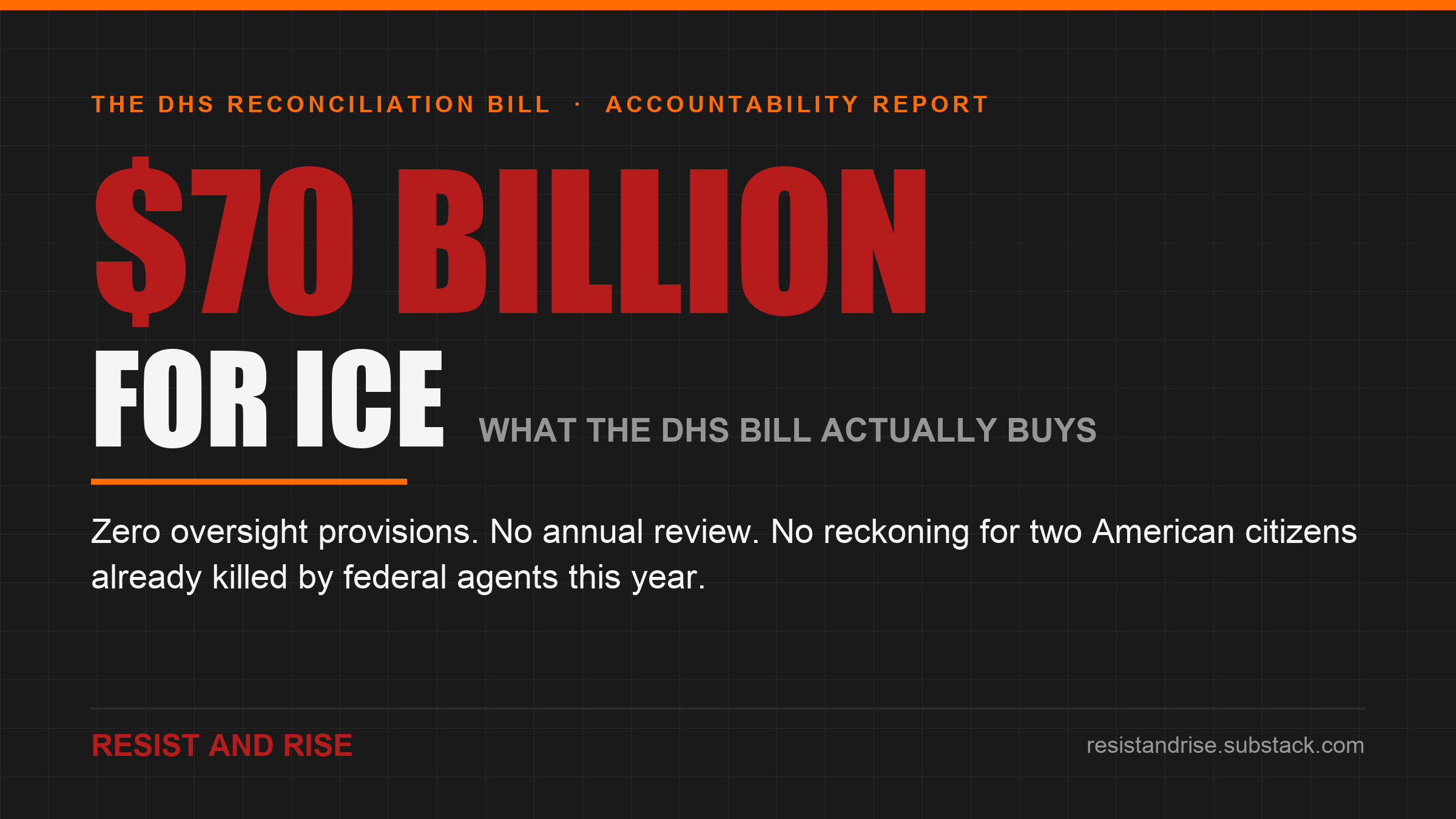
Senate Republicans just voted to debate a $72 billion blank check for ICE and CBP with no oversight provisions, no annual review, and no reckoning for two American citizens already killed by federal agents this year.
The Senate voted 53-46 on June 3 to open debate on a $72 billion immigration enforcement package, strictly along party lines. The vote-a-rama is coming the night of June 4. If that passes, the House could vote Friday.
Once signed, this money is locked in through fiscal year 2029. No annual review. No congressional reporting requirements. No facility inspection rights. No spending directives.
Democrats spent months demanding accountability provisions as the price of DHS funding: body cameras, judicial warrant requirements, independent investigations of agent-caused deaths. Every single reform was rejected. The bill that emerged contains none of them.
This isn't a border security investment with some paperwork gaps. It is a structural accountability void, engineered deliberately, presented as fiscal policy.
What's Actually in the $72 Billion DHS Reconciliation Bill
The top-line figure is $72 billion. The Congressional Budget Office projects the real cost at approximately $94 billion once financing costs are included.
Here is what that money buys, per Roll Call's analysis of the bill text:
$38.2 billion for ICE: $30.73 billion for hiring, training, deportation transportation, IT systems, and 287(g) local law enforcement partnerships; $7.45 billion for Homeland Security Investigations
$26+ billion for CBP: $22.6 billion for Border Patrol and agency personnel, $3.45 billion for surveillance technology including artificial intelligence and machine learning systems
$10 billion for detention expansion: targeted at building toward a 50,000-bed baseline, even as the system already houses more than 70,000 people
All of it available as a lump sum through 2029. No annual review. No reprogramming restrictions.
This is not the first major enforcement package.

The One Big Beautiful Bill Act, signed in July 2025, delivered $170.7 billion for immigration enforcement, including $75 billion for ICE over four years and a roughly 400% increase in ICE's annual detention budget compared to the prior year. The Brennan Center for Justice described the combined packages as representing a buildup of domestic law enforcement without precedent in peacetime American history.
The money is already flowing. ICE is converting commercial warehouses into detention facilities under what it calls a "Detention Re-engineering Initiative." The ACLU documented ICE paying $102.4 million for a Maryland warehouse appraised at $76.8 million, $87 million for a Pennsylvania warehouse, and $122.8 million for an 826,780-square-foot facility near El Paso. If the full expansion proceeds, simultaneous detention capacity would reach 96,600 people.
"Long-term detention and surveillance contracts, rapid hiring increases for enforcement, and new monetary incentives for reprioritizing law enforcement on immigration will create a deportation-industrial complex — an enforcement machine with financial and political constituencies that will outlast this administration."
— Brennan Center for Justice, 2026
Nearly 90 percent of people in ICE custody are held in facilities run by for-profit firms, according to the Brennan Center. GEO Group reported $254 million in profit in its most recent year, a roughly 700% increase over 2024, driven by ICE detention contracts, per Common Dreams. CoreCivic reported $116.5 million in 2025 profits, a nearly 70% year-over-year increase, per NOTUS.
The 287(g) program deputizes local police as immigration enforcement. The ACLU documented ICE expanding those local law enforcement partnerships from 135 contracts in December 2024 to at least 1,712 contracts across 40 states by April 2026. The reconciliation bill funds between $1.4 billion and $2 billion annually for those partnerships, turning local police departments into immigration enforcement arms in communities that never voted for that role.
Zero Accountability: What Got Left Out
The federal appropriations process has oversight mechanisms built in as standard infrastructure: annual review cycles, facility inspection rights, spending directives, and reporting mandates. These are not extras. They are the baseline conditions under which federal agencies spend public money.
Budget reconciliation is a financing mechanism, not an authorization bill. Choosing reconciliation over appropriations strips those mechanisms out. That choice was deliberate.
The American Immigration Council made the accountability void explicit: since February 14, Democrats demanded warrant requirements, professional law enforcement standards, body camera mandates, and independent death investigations as the price of DHS funding. Every reform was rejected. The bill contains none of those provisions.
"Because these funds are provided through reconciliation — and not the regular appropriations process — they do not include directives about how the funds must be used, which prevents members of Congress from conducting meaningful oversight."
— American Immigration Council, June 2026
The Congressional Budget Office flagged the problem in understated agency language: "There is considerable uncertainty over the pace of spending given the lack of guardrails on when the money can be spent," per the CBO's May 2026 cost estimate.
The accountability void extends into how ICE trains the agents it's now hiring at record speed. ICE lowered its recruit age from 21 to 18, waived the 37-year-old hiring cap, and slashed the training academy from 22 weeks to 47 days. The number was reportedly chosen because Trump is the 47th president, per CNN's February 2026 analysis and Detroit News reporting. Brookings Institution scholars Gabriel Sanchez and Rashawn Ray documented that ICE's expansion has structurally outpaced any accountability mechanism.
ICE met its legally required 48-hour death notice deadline in only 15 of 49 cases since January 2025. The agency that can't meet its own reporting requirements is about to receive $38 billion with no reporting requirements attached.
Two U.S. Citizens Dead, No Reckoning in the Bill
Renée Nicole Good, 37, was shot by ICE deportation officer Jonathan Ross on January 7 in Minneapolis's Central neighborhood during a mass enforcement operation called Operation Metro Surge. The Intercept identified the shooter the following day. An autopsy commissioned by her family found she was shot in the head. Minneapolis Mayor Jacob Frey said during a CNN interview that federal authorities claimed her vehicle was used as a weapon, a characterization disputed by local officials and video evidence.

Alex Jeffrey Pretti, 37, a licensed intensive care nurse employed by the U.S. Department of Veterans Affairs, was shot and killed by CBP officers Jesus Ochoa and Raymundo Gutierrez on January 24 while observing protests that followed Good's killing. He wasn't marching. He was watching. ProPublica identified both agents by name on February 1 after examining government records, a disclosure the federal government had not made.
The initial White House account described Pretti as threatening agents with a weapon. An internal government assessment obtained by NPR made no mention of Pretti attacking or threatening officers with a weapon.
Minnesota, Hennepin County, and the Minnesota Bureau of Criminal Apprehension filed suit on March 24 against the DOJ and DHS, alleging the defendants were withholding investigative evidence about both killings and the separate shooting of Julio Sosa-Celis, documented by ProPublica and the Minnesota Reformer. The federal government handed over evidence in Good's case on May 6, only after court compulsion. As of April 10, NPR confirmed that a federal accountability mechanism "remains elusive."
"The ICE shooting investigations are a 'Complete Aberration.'"
— The Marshall Project, characterizing legal experts' assessment, January 2026
The $72 billion reconciliation bill contains no provision requiring a federal investigation of either killing. No use-of-force standard. No body camera mandate. No independent review process.
ICE fired at people nine times across five states and D.C. between September 2025 and January 2026, before the Minneapolis killings, per the American Immigration Council. At least 17 people died in ICE custody in the first four months of 2026 alone, a rate of roughly one per week, per Democracy Now. The fiscal year 2026 death toll, counting from October 2025, has already surpassed the FY 2004 record, according to CBS News.
Children in ICE detention increased tenfold since the start of Trump's second term, reaching over 6,200, per The Marshall Project.
The bill that passed a procedural vote today does not acknowledge that any of these people existed.
The Parliamentarian Ruling and What Happens Next
In mid-May 2026, Senate Parliamentarian Elizabeth MacDonough ruled that several provisions in the bill violated the Byrd rule, the Senate's internal guardrail against using reconciliation to pass substantive policy changes that don't directly affect the federal budget. The struck provisions included the core Border Patrol funding architecture, a provision on unaccompanied migrant children screening, and $2.5 billion in DHS block appropriations that conflicted with the Flores Settlement Agreement protecting detained children, per The Hill. Senate Democrats, including Budget Committee Ranking Member Jeff Merkley's office, characterized the ruling as a major setback.
Republicans described the revisions as "technical fixes." The parliamentarian also struck approximately $1 billion for Secret Service presidential ballroom security, per NBC News.
Here is what the parliamentarian ruling did not do: it did not add oversight. It did not add body cameras. It did not add warrant requirements. It did not require a single death investigation. The accountability void is not a Byrd rule question. It was never in the bill to begin with.
The $72 billion core survived. The money flows. The oversight doesn't exist.
The Flores Settlement conflict remains an active legal dispute. The Ninth Circuit is scheduled to hear arguments in June 2026 on the government's attempt to terminate the Settlement, even as the reconciliation bill continues to fund detention expansion that experts argue violates Flores protections for children.
What It Means
This is not a temporary surge. The Brennan Center documented the design explicitly: long-term contracts, hired enforcement personnel, private detention infrastructure, and local law enforcement partnerships all create constituencies that will outlast this administration. An agency with a blank check becomes politically impossible to defund, because the financial interests defending that check are bipartisan, local, and durable.
Taken together, the $170.7 billion One Big Beautiful Bill Act plus this $72 billion package represent the largest peacetime domestic law enforcement investment in American history. It funds an agency that records a death in its custody roughly once a week, kills U.S. citizens and then withholds evidence, trains recruits for 47 days, and met fewer than one-third of its own legal reporting deadlines in the last year.
The choice of reconciliation over appropriations is not a procedural accident. It is the mechanism that makes accountability optional. And it is working exactly as designed.
What's Next
June 4, 2026: Senate vote-a-rama: Following up to 20 hours of debate, Democrats will force Republicans to vote on explicit accountability amendments: body cameras, warrant requirements, independent death investigations. Every vote is on public record. Watch how Murkowski (R-AK), Collins (R-ME), and Paul (R-KY) vote, the only three Republicans who have broken with their caucus on ICE-related votes in 2026.
June 5–6, 2026: House floor vote: Speaker Johnson has targeted Friday. If the House passes an identical text, the bill goes to Trump. If the House text differs, watch for a conference process or a House take-it-or-leave-it vote on the Senate version, per ABC News.
June 2026: Ninth Circuit, Flores Settlement arguments: The court hears arguments on the government's attempt to terminate the Flores Settlement Agreement. The outcome determines whether the reconciliation bill's detention funding faces legal constraints protecting detained children.
Ongoing: ICE custody death count: The fiscal year 2026 death toll has already passed the FY 2004 record. Detention capacity is expanding toward 96,600 simultaneous beds. ICE met its 48-hour death reporting deadline in only 15 of 49 cases since January 2025, meaning the real numbers are likely worse than what's publicly reported.
Once this bill is signed, these funds are locked in through fiscal year 2029. There is no annual appropriations lever to adjust course.
What You Can Do
The vote-a-rama is the last window. The American Immigration Council's action page has direct contact tools for the Senate.
Three senators have demonstrated they will break with the Republican caucus on ICE funding votes:
Sen. Lisa Murkowski (R-AK): 202-224-6665
Sen. Susan Collins (R-ME): 202-224-2523
Sen. Rand Paul (R-KY): 202-224-4343
The ask is specific, not abstract opposition to enforcement funding, but four concrete provisions that every other federal law enforcement agency operates under: body cameras, judicial warrant requirements for arrests in sensitive locations, mandatory independent investigations of agent-caused deaths, and annual reporting to Congress on detention conditions and use-of-force incidents.
If you are in a district with a Republican House member, Friday is the House vote target. Call before Friday morning. Use the Congressional switchboard at 202-224-3121 to reach any member's office.
The ACLU's immigration action center tracks ongoing litigation including the Flores Settlement case and the Minnesota state lawsuit. Follow the Brennan Center's immigration enforcement reporting for post-passage accountability tracking.
Methods & Verification: This article draws on primary source documents including the Congressional Budget Office's May 4, 2026 cost estimate, the Senate parliamentarian's advisory published through the Senate Budget Committee's ranking member, and ICE's official death reporting database. All key claims are corroborated by at least two independent sources — investigative outlets including ProPublica, NPR, The Intercept, and The Marshall Project alongside policy analysis from the American Immigration Council, Brennan Center for Justice, ACLU, and Brookings Institution. As of publication on June 3, 2026, the vote-a-rama has not yet occurred; final amendment outcomes and passage votes will be reported separately.