


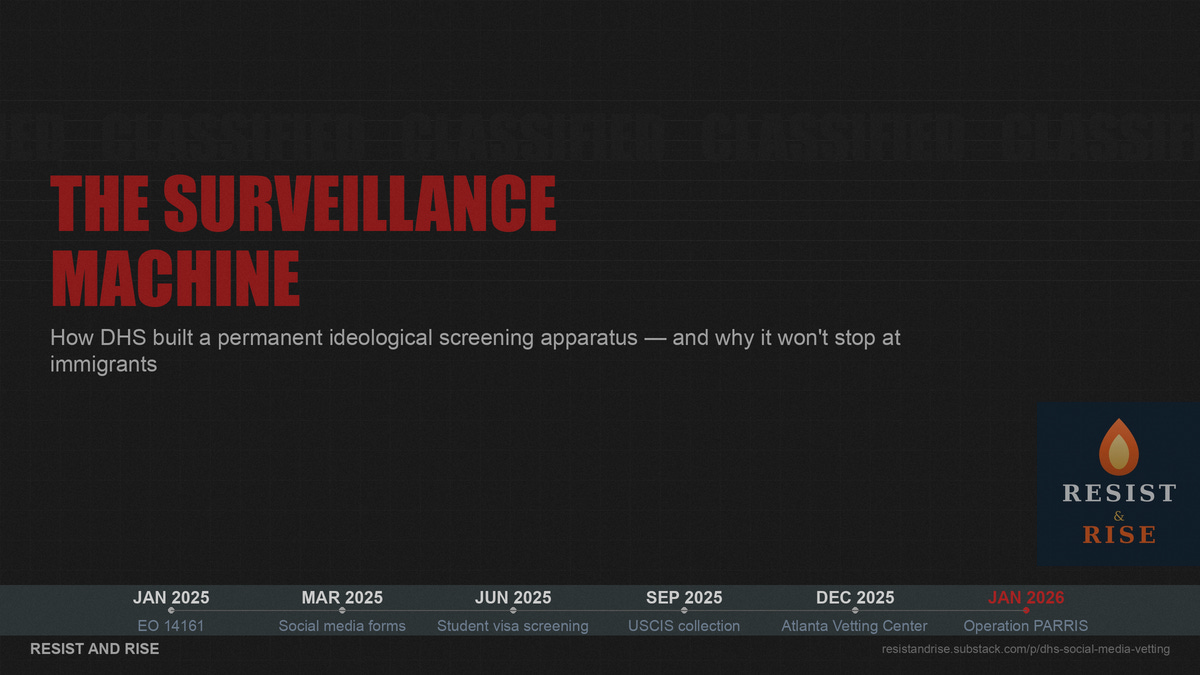
The U.S. government is building a permanent ideological screening apparatus under the guise of “extreme vetting.” If you think it ends at the border, you haven’t been paying attention.
Somewhere in Atlanta, a new government facility is spinning up AI tools to retroactively review the social media accounts of people the United States already approved for entry. In Vermont and California, ICE is hiring contractors to monitor social media posts around the clock: eight billion per day, in over a hundred languages. And in immigration offices across the country, applicants are being told to set every social media account to “public” so federal officers can scroll through their posts, their likes, their comments, and their connections.
This is what “extreme vetting” looks like in practice.
The infrastructure being built today will not stay pointed at immigrants.
What Changed: Executive Order 14161 and the Scope of the Dragnet
Donald Trump signed Executive Order 14161 on Inauguration Day, January 20, 2025. The order directed all federal agencies to “enhance screening and vetting” of foreign nationals, language vague enough to justify almost anything. What followed was the most expansive social media surveillance regime ever deployed against immigrants in this country.
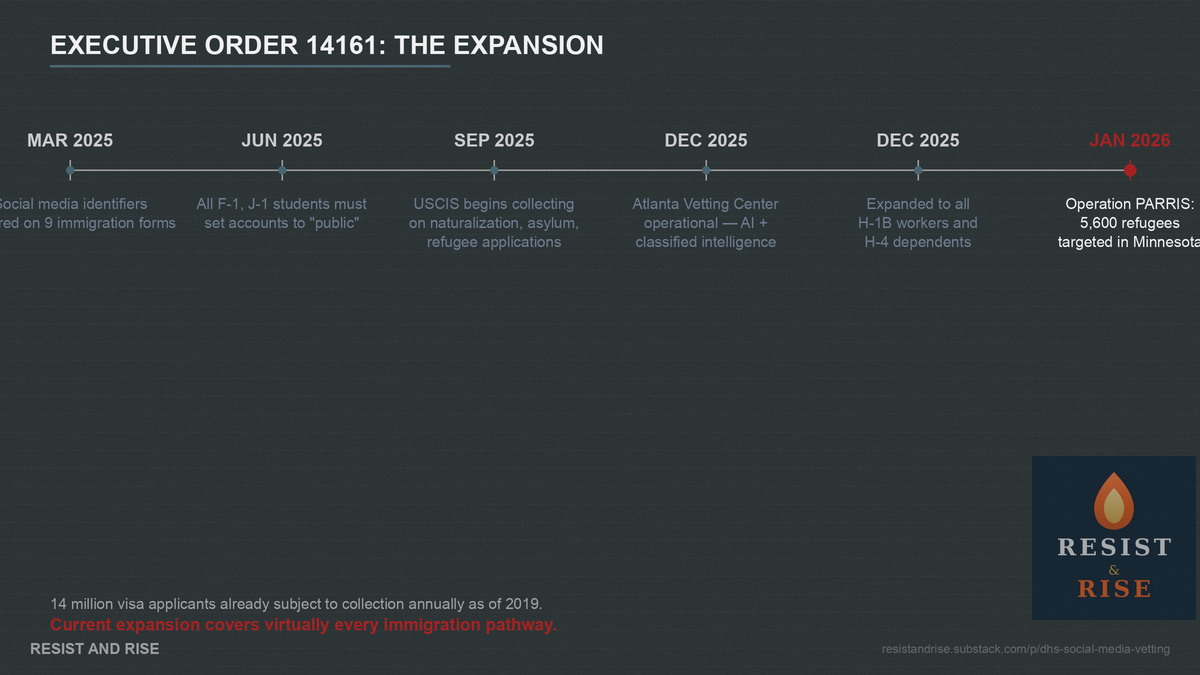
Here is what happened in the twelve months since:
March 2025: DHS published a Federal Register notice requiring social media identifier disclosure on nine immigration forms, covering visa applicants, green card applicants, asylum seekers, and citizenship applicants.
June 2025: The State Department mandated social media screening for all F-1 students, J-1 exchange visitors, and their dependents. Every applicant must set all social media accounts to “public.”
September 2025: USCIS announced it would begin collecting social media identifiers on applications for naturalization, adjustment of status, asylum, and refugee classification.
December 2025: USCIS established a new Vetting Center in Atlanta, leveraging AI and classified intelligence to conduct reviews of all immigration applications, including retroactive reviews of previously approved cases. That same month, social media screening expanded to cover all H-1B workers and their H-4 dependents.
January 2026: USCIS launched Operation PARRIS in Minnesota, targeting approximately 5,600 refugees for retroactive background checks and reinterviews.
This is not a pilot program. It is not a narrow counter-terrorism measure. Fourteen million visa applicants were already subject to social media collection annually as of 2019. The current expansion covers virtually every immigration pathway into the country.
How the Surveillance Machine Actually Works
The system operates in layers. Each one feeds into permanent government databases.
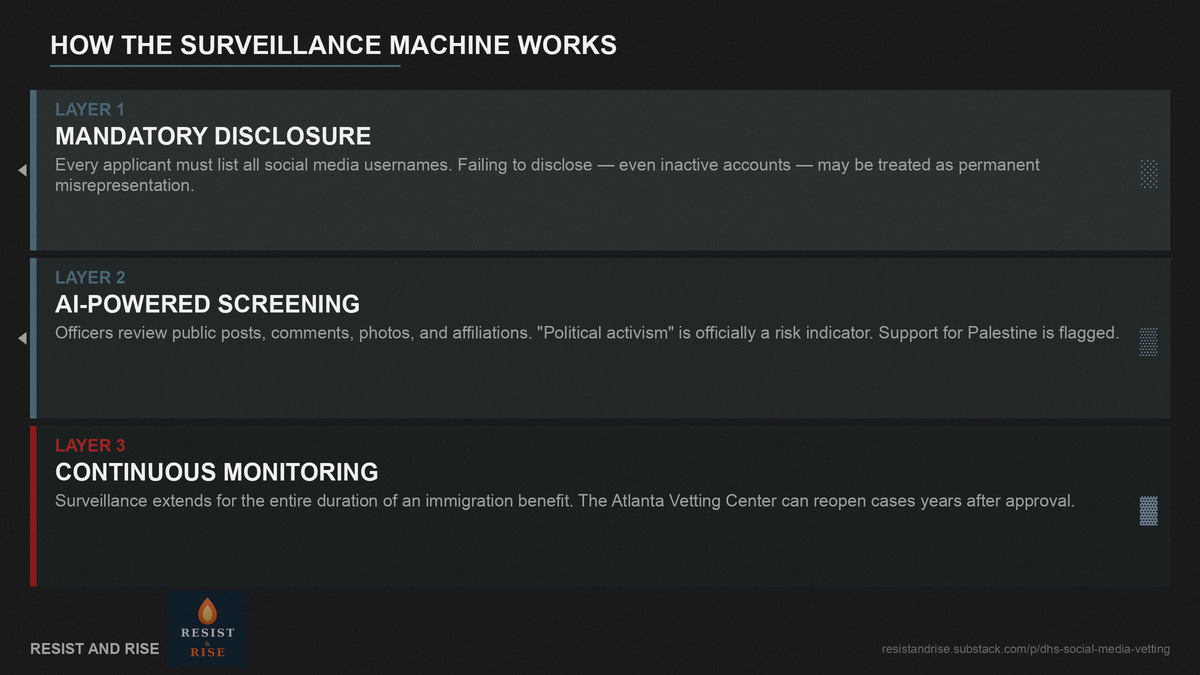
Layer 1: Mandatory Disclosure
Every applicant in the H-1B, H-4, F, M, and J visa categories is now required to set all social media profiles to “public” and list every username, handle, or screen name on their DS-160 application. Failing to disclose an account, even an inactive one, may be treated as misrepresentation, potentially barring the applicant from future immigration benefits. Permanently.
Layer 2: AI-Powered Screening
Consular officers and USCIS adjudicators review public posts, comments, photos, and affiliations across X/Twitter, Facebook, Instagram, YouTube, TikTok, and LinkedIn. According to immigration law firms tracking the policy, officers are directed to look for “hostile attitudes” toward the United States, a history of “political activism,” content construed as “pro-socialist or communist,” and support for Palestine, flagged as a “hot button” under the current administration.
Read that again. Political activism is now officially a risk indicator for immigration benefits. Not violence. Not threats. Activism.
Layer 3: Monitoring That Never Ends
USCIS’s Continuous Immigration Vetting program is being expanded to cover the entire duration of an immigration benefit, until the individual becomes a naturalized U.S. citizen. The Atlanta Vetting Center will combine classified and unclassified screening with AI analytics to conduct retroactive reviews of already-approved applications. The government can reopen your case years after approval.
The Tools in the Arsenal
ICE has invested tens of millions in surveillance technology to make this work:
Zignal Labs: A $5.7 million contract for a platform that ingests over eight billion social media posts per day in more than 100 languages, using machine learning and computer vision to extract metadata, geolocation, faces, and social connections.
Babel X: Links social media profiles and location data to an individual’s Social Security number.
Clearview AI: A facial recognition contract worth $9.2 million.
Paragon Solutions: A $2 million cellphone hacking tool that can remotely access location data, messages, and photographs.
Palantir Immigration OS: Automates mass surveillance and risk assessments of non-U.S. citizens.
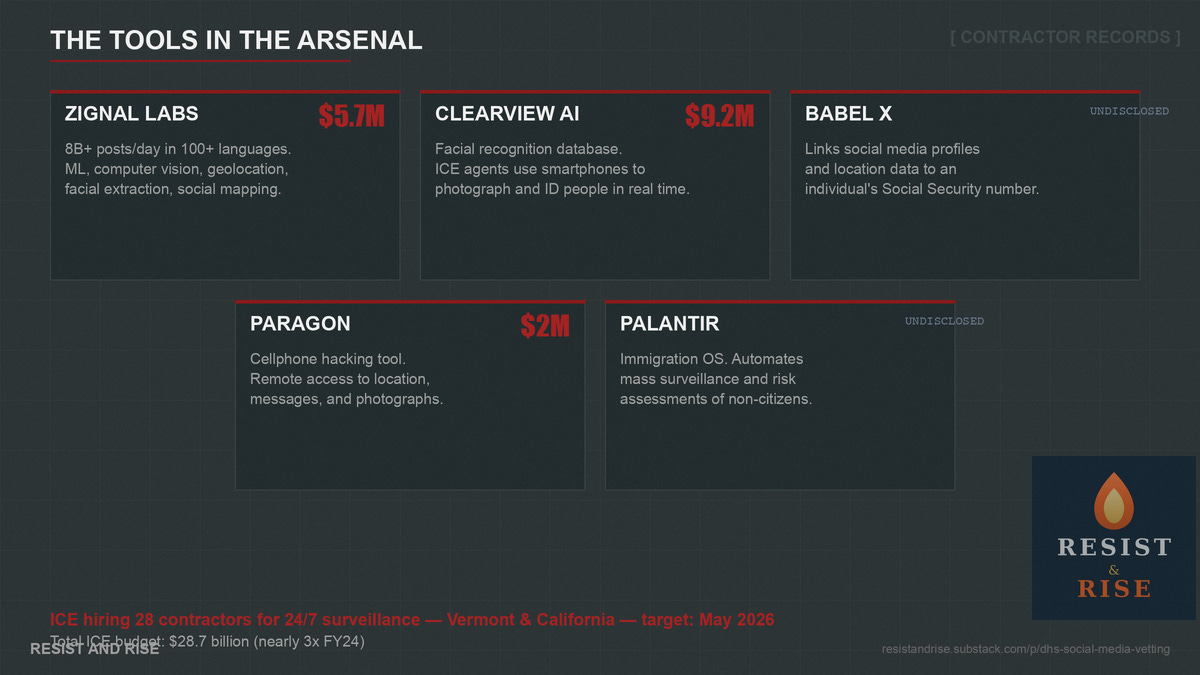
ICE plans to hire at least 28 contracted workers for 24/7 social media surveillance teams at facilities in Vermont and California, with operations expected to begin as early as May 2026. After supplemental appropriations, ICE’s budget has ballooned to $28.7 billion, nearly triple FY24 levels.
This is not vetting. This is an industrial surveillance operation.
The Constitutional Crisis No One Wants to Name
The First Amendment protects the right to speak, associate, and petition the government. Those rights apply to all persons on U.S. soil, not just citizens. But what does that protection mean when exercising it can cost you your visa, your green card, or your shot at citizenship?
The chilling effect is not theoretical. It is documented. And it is deliberate.
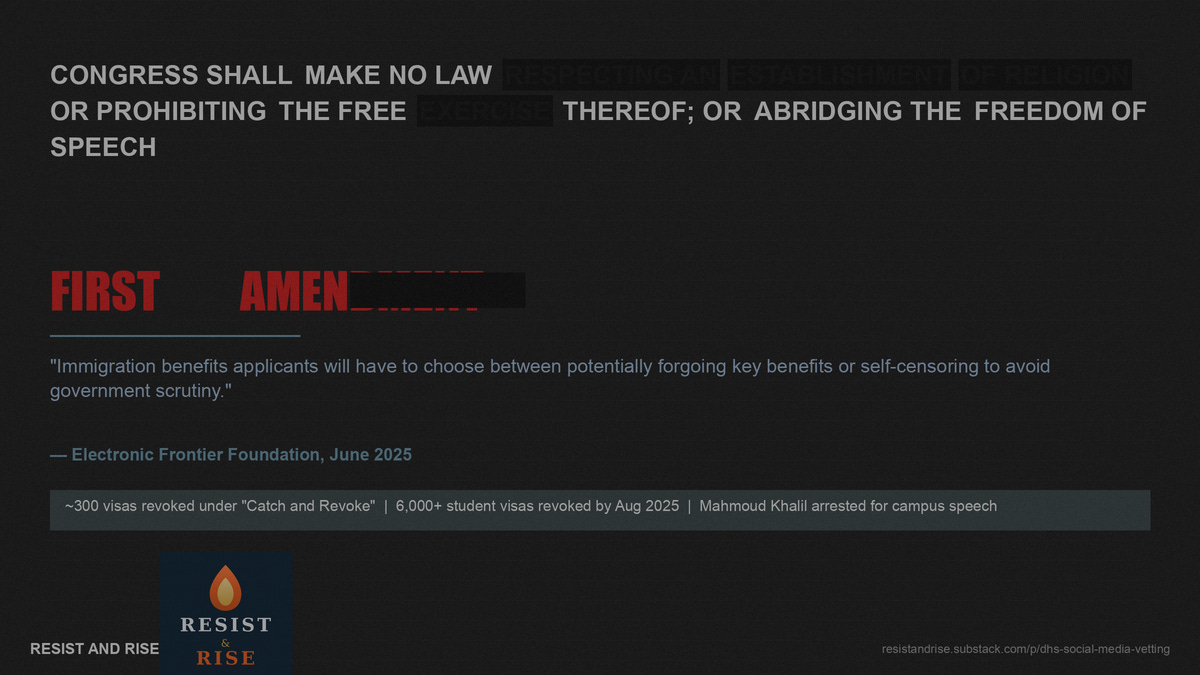
Immigration attorneys across the country are now advising clients to self-censor their social media activity. The Electronic Frontier Foundation has explicitly warned that immigration benefits applicants will have to choose between potentially forgoing key benefits or self-censoring to avoid government scrutiny. Applicants may avoid speaking out on social media about American foreign policy or expressing views about other political topics that may be considered controversial (EFF, June 2025).
Government retaliation against protected speech is already happening.
Mahmoud Khalil, a Columbia University graduate student, green card holder, and husband of an American citizen, was arrested by ICE on March 8, 2025, for his role in pro-Palestinian campus protests. The Trump administration invoked a rarely used provision allowing deportation of non-citizens whose “presence or activities” compromise a “compelling U.S. foreign policy interest.” That determination was made by Secretary of State Marco Rubio, based on Khalil’s speech.
On February 2, 2026, the ACLU filed a federal motion to quash a DHS administrative subpoena seeking Google subscriber records for a man whose only “offense” was sending an email to a DHS attorney urging “common sense and decency” in an Afghan asylum seeker’s case.
DHS issued the subpoena four hours after receiving the email.
Four hours. That is how long it takes the federal government to retaliate against protected speech in 2026.
The State Department’s “Catch and Revoke” program uses AI to scan tens of thousands of student visa holders’ social media for evidence of alleged terrorist sympathies, particularly related to pro-Palestinian advocacy. Critics have documented that many targeted individuals never expressed support for Hamas; they were involved in anti-war protests or calls for university divestment (EFF, April 2025). Approximately 300 visas have been revoked under the program, with over 6,000 student visas revoked overall by August 2025.
The Knight First Amendment Institute at Columbia University put it plainly: “Immigrant communities are being sent a clear message: Speak out against detention and deportation, and you will be detained and deported” (Knight Institute).
Why This Won’t Stay Limited to Immigrants
If you are a U.S. citizen reading this and thinking “this doesn’t affect me,” it already does.
When DHS reviews an immigrant’s social media, it necessarily captures the speech, associations, and communications of every U.S. citizen who interacts with that immigrant online. The National Immigration Law Center has documented that DHS is “collecting information on immigrants’ and citizens’ social media use and making it part of their permanent records.” The EFF confirmed the current system “widens the government’s social media surveillance dragnet to include not only travelers, visa applicants, and visa holders, but also their U.S. citizen contacts.”
Your comments. Your likes. Your conversations with immigrant friends and family. All of it swept into permanent government databases.
The historical pattern here is unmistakable. The PATRIOT Act was sold as targeting foreign terrorists. Within years, the FBI was conducting physical searches and wiretaps on American citizens without proving probable cause. The NSA’s PRISM program targeted foreign communications but swept up millions of Americans’ data. In 2021 alone, the FBI conducted up to 3.4 million warrantless searches of Americans’ communications using Section 702 of FISA, a law built to target foreigners overseas.
The Brennan Center for Justice published an expert brief in November 2025 warning that ICE surveillance tools are being positioned to target not just immigrants but “political dissenters, protesters, and critics.” The federal government “openly says it will use its supercharged spy capabilities to target people who oppose ICE’s actions, labeled as ‘domestic terrorists’ by the administration, including anti-ICE protesters and anyone who allegedly funds them.”
Zignal Labs, Babel X, ShadowDragon, Clearview AI, and Paragon: these tools do not distinguish between citizens and non-citizens. They analyze all publicly available social media posts, map all social connections, and can be deployed against any target. ICE agents are already using smartphones loaded with facial recognition technology to photograph people they encounter in daily operations, including U.S. citizens, running the images through recognition software in real time.
The surveillance infrastructure built for “the other” always becomes the surveillance infrastructure deployed against everyone. That is not a warning. It is a historical fact.
What It Means
This is not a policy disagreement. This is the construction of a permanent ideological screening machine funded by $75 billion in appropriations over four years.
DHS’s own pilot programs in 2016 found social media monitoring was “largely ineffective” in identifying threats to public safety or national security. What the programs were designed to focus on, according to FOIA records, were Muslim communities. Not terrorists. Not security threats. Just Muslims being Muslim online.
They built it anyway. They are expanding it. And they are spending billions to make it permanent.
The question is not whether this system will be turned on American citizens. The question is how long before that fact becomes impossible to deny.
What’s Next
Watch for these developments in the coming months:
USCIS Vetting Center full operationalization: The Atlanta facility’s AI-powered retroactive reviews could expand beyond Operation PARRIS to additional states and populations at any time.
ICE 24/7 surveillance teams going live (target: May 2026): The contracted teams in Vermont and California will create permanent around-the-clock social media monitoring capacity. Their deployment scope will signal whether this tool is being aimed beyond immigration enforcement.
Federal court rulings on surveillance challenges: The ACLU’s Doe v. DHS case challenging retaliatory subpoenas, U.H.A. v. Bondi challenging Operation PARRIS and the Knight Institute’s challenge to “Catch and Revoke” could establish critical precedents on whether the government can use immigration powers to punish protected speech. Key rulings are expected throughout 2026.
What You Can Do
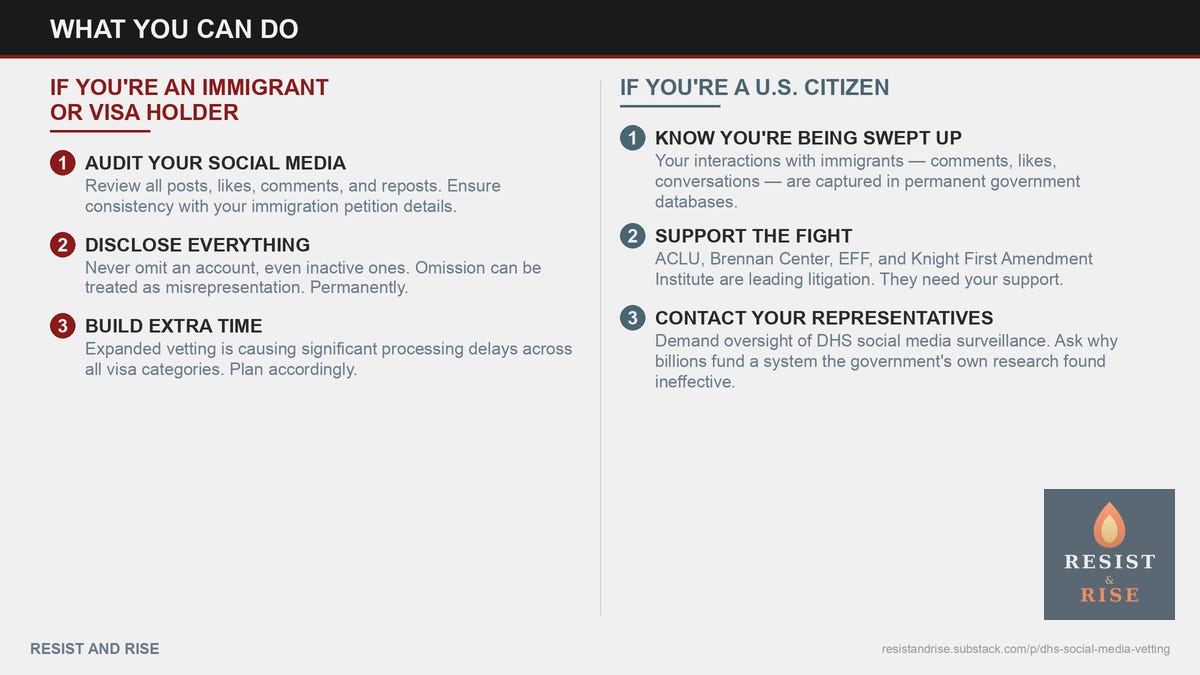
If you are an immigrant or visa holder:
Audit your social media now. Review all posts, likes, comments, and reposts. Make sure your online presence is consistent with your immigration petition details. Consult an immigration attorney before any filing if your social media includes political content.
Disclose everything. Never omit a social media account from your application, even if inactive. Omission can be treated as misrepresentation.
Build extra time into your schedule. Expanded vetting is causing significant processing delays across all visa categories.
If you are a U.S. citizen:
Know that your interactions with immigrants are being monitored and may become part of permanent government records.
Support the organizations fighting back. The ACLU has launched a survey collecting stories from people affected by social media surveillance. The Brennan Center, EFF, and Knight First Amendment Institute are leading litigation efforts.
Contact your representatives. Demand oversight of DHS social media surveillance programs. Ask why billions are being spent on a system the government’s own research found largely ineffective.
Methods & Verification: This article draws on primary government sources (executive orders, Federal Register notices, USCIS press releases, State Department announcements), legal analysis from immigration law firms (Fisher Phillips, Seyfarth Shaw, Duane Morris, Gibney Anthony & Flaherty), investigative journalism (NPR, NBC News, Axios, TIME, Truthout, VTDigger), and analysis from civil liberties organizations (ACLU, Brennan Center, EFF, Knight First Amendment Institute, Amnesty International, NILC, EPIC). Key claims were cross-referenced across multiple independent sources. DHS pilot program ineffectiveness findings were documented by the Brennan Center through FOIA-obtained records.
Sources
· Brennan Center for Justice, “Social Media Surveillance by the U.S. Government”
· EPIC v. ICE: Location and Social Media Surveillance
· Borderless Magazine, “ICE Social Media Surveillance”, January 2026
Georgetown Law, “ICE Violating First Amendment by Targeting Immigrant Rights Advocates”