


50% off locks in forever. This offer has been extended until the end of the year. Sign up and pay $25 for a full year. Your 50% discount stays as long as you subscribe.
The surveillance platform powering mass deportation is live. The architect of the policy? He held stock in the company building it.
It sounds clinical on paper. A $30 million government contract for “immigration lifecycle management.” What ImmigrationOS actually is: the algorithmic engine driving the largest mass deportation operation in American history. A system built to identify, track, and target your neighbors in real time.
Palantir Technologies built the platform. It went live in late 2025. ICE wants 3,000 arrests a day, and ImmigrationOS is how they plan to get there. The system hoovers up data from IRS records, Social Security files, passport databases, and license plate readers. Then AI does the sorting. Flags people for removal.
The administration keeps talking about “the worst of the worst.” The numbers tell a different story.
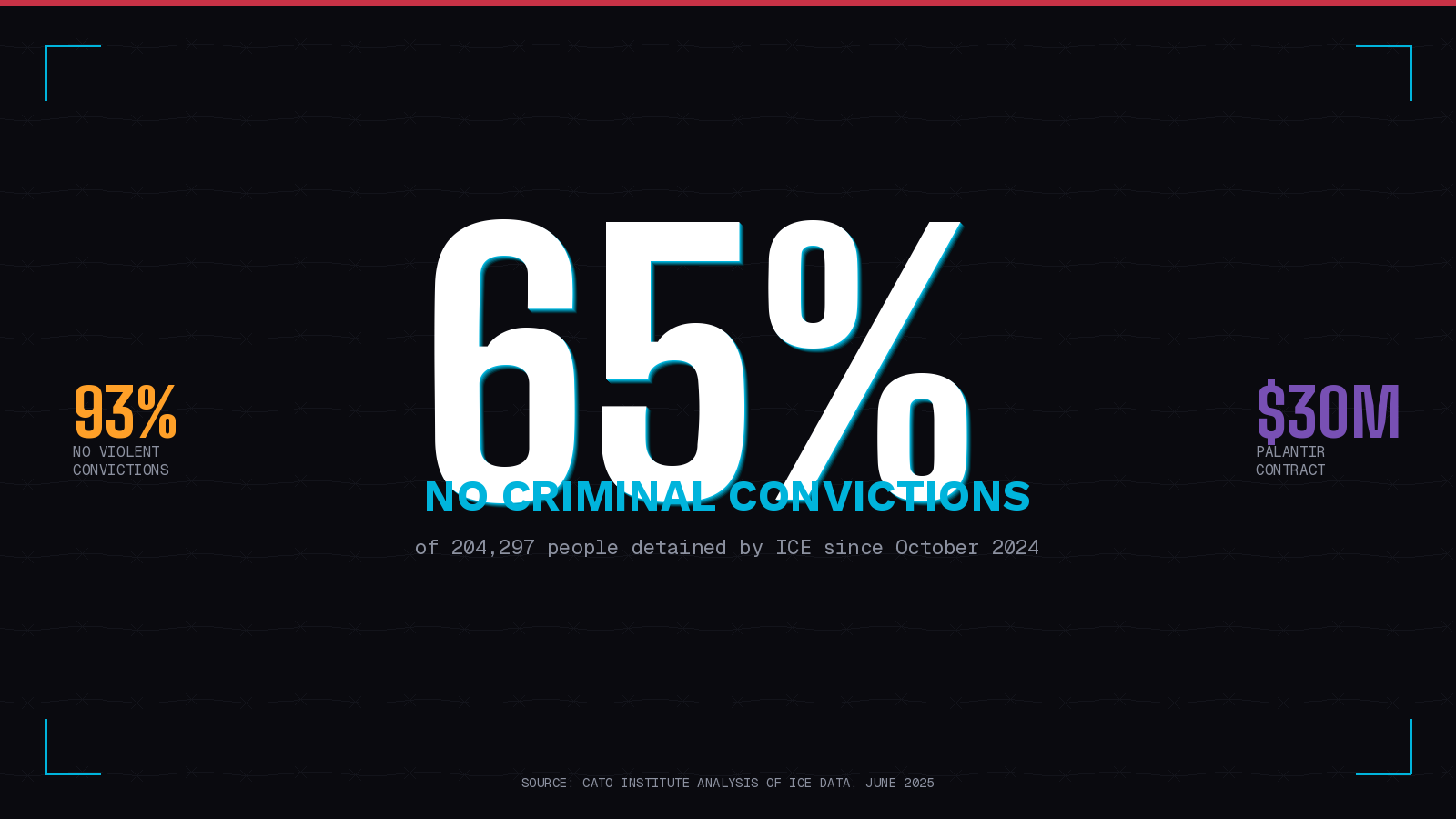
Cato Institute analysis of nonpublic ICE data found that 65 percent of people booked into detention since October 2024 have zero criminal convictions. Only 6.9 percent had violent convictions. That’s the data. The rhetoric doesn’t match.
How ImmigrationOS Powers Mass Deportation
This isn’t Palantir’s first rodeo with ICE. Not even close.
The relationship goes back to 2014, when the Obama administration handed the company a $41 million contract for its Investigative Case Management platform. That contract survived through both parties’ administrations, ballooning to roughly $90 million by 2022.
What’s different now? The April 2025 contract added three capabilities that fundamentally change what ICE can do: predictive targeting of individuals for removal, real-time tracking of “self-deportations,” and streamlined logistics from identification to expulsion.
The contract justification document doesn’t mince words: “Palantir is the only source that can provide the required capabilities and prototype of ImmigrationOS without causing unacceptable delays.”
No competitive bidding. No outside scrutiny. No alternative vendors were even considered.
“In supporting the Trump administration’s deportation apparatus, Palantir is complicit in those human rights and constitutional violations.” — Mariana Olaizola Rosenblat, Policy Adviser, NYU Stern Center for Business and Human Rights (April 2025)

Follow the Money: The Miller Connection
Here’s the conflict of interest nobody’s talking about.
Stephen Miller designs the policies. He’s the White House Deputy Chief of Staff for Policy and the architect of Trump’s immigration crackdown. He also held between $100,001 and $250,000 in Palantir stock while doing it.
Technically, the stock sat in a brokerage account for one of his kids. Doesn’t matter. Federal ethics rules treat holdings for minor children the same as direct ownership.
Don Fox, who used to run the Office of Government Ethics, told the Project on Government Oversight that Miller’s situation “is more than just a bad look—it could easily become a serious ethics issue. If he hasn’t stepped over the line, he’s just on the verge of it.”
Miller finally sold his shares in August 2025. Nine months after taking his White House job. Four months after ICE awarded the ImmigrationOS contract. During that window, Palantir’s stock shot up more than 200 percent, fueled partly by a government contract portfolio that now tops $900 million since Trump took office.
He wasn’t alone. At least 11 other White House officials and DHS appointees owned Palantir stock too, according to POGO’s review of financial disclosures.
When ImmigrationOS Targets the Wrong People
Caroline Dias Goncalves found out the hard way what happens when surveillance infrastructure collides with arrest quotas.
June 5, 2025. She’s 19, a nursing student at the University of Utah, driving through Colorado to see a friend. A sheriff’s deputy pulls her over for following a semi-truck too closely. He asks where she was born. Brazil, she tells him. She’d lived in Utah since she was 7. Had a pending asylum case. No criminal record.
The deputy let her go with a warning. But he’d already shared her information through an encrypted messaging app to a multi-agency group. ICE agents were watching. Minutes later, down the highway, they stopped her again. Arrested her without showing a warrant. Took her to the Aurora detention center.
“The past 15 days have been the hardest of my life,” she said after her release. “I was placed in a system that treated me like I didn’t matter.”
She’s now a plaintiff in an ACLU class-action lawsuit. On November 25, 2025, Federal Judge R. Brooke Jackson ruled that ICE agents in Colorado had “routinely” conducted unlawful warrantless arrests. He ordered them to stop.
“ICE cannot terrify our communities with their haphazard warrantless arrests,” said Tim Macdonald, the ACLU of Colorado’s legal director. “A federal court has now declared that ICE must immediately stop these aggressive and unlawful tactics.”
What It Means: The Deportation-Industrial Complex
Look at where the money’s going. It tells you everything.
The “One Big Beautiful Act” puts $170 billion toward immigration enforcement over four years. That’s more than the yearly budgets of every state and local law enforcement agency in America combined. ICE’s 2025 budget nearly tripled to $28.7 billion, per the Brennan Center’s analysis.
Lauren-Brooke Eisen, Senior Director of the Brennan Center’s Justice Program, called it what it is: “a deportation-industrial complex—an enforcement machine with financial and political constituencies that will outlast this administration.”
Even some Palantir insiders are sounding alarms. Thirteen former employees published an open letter through NPR warning that the company abandoned its principles: “Government databases are already erasing references to transgender people and gender-affirming care. These injustices could be facilitated by the very software infrastructure we helped build.”
ImmigrationOS: What to Watch
Three things to watch:
The appeal. DHS will challenge Judge Jackson’s Colorado ruling. The Tenth Circuit’s decision could set a national precedent on warrantless arrests. Expect movement in December 2025 or January 2026.
Contract expansion. ImmigrationOS runs through September 2027. Keep an eye on USASpending.gov for scope increases and budget bumps.
Congressional action. Senator Ron Wyden sent Palantir a letter in June 2025 demanding they preserve records. Whether actual hearings happen remains to be seen.
See All Resist and Rise Palantir Articles
What You Can Do
File FOIA requests. Target ImmigrationOS deployment data and Privacy Impact Assessments. ICE hasn’t published any public assessment of the system’s civil liberties implications. That’s a problem.
Connect with rapid response networks. If you witness an ICE arrest, document it.
Know your rights. ICE can’t enter your home without a judicial warrant signed by a judge. United We Dream has Know Your Rights resources in multiple languages.
Call your representatives. Demand oversight of Palantir’s contracts and the conflicts of interest surrounding them.
Methods & Verification
Factual claims were checked against primary sources: federal contract documents on USASpending.gov, court filings from the U.S. District Court of Colorado, and records from POGO, ACLU, and the Brennan Center. Quotes and statistics confirmed through original reporting from NPR and Cato Institute analysis of nonpublic ICE data. All source links verified as accessible as of December 3, 2025.
Resist and Rise publishes twice weekly. Subscribe for investigative reporting on surveillance, civil liberties, and community resistance.
Sources
Brennan Center for Justice, “Big Budget Act Creates a ‘Deportation-Industrial Complex’” (July 2025)
NPR, “Former Palantir workers condemn company’s work with Trump administration” (May 5, 2025)
Surveillance on Trial: The New Wave of Resistance Against Palantir’s Expanding Empire (Sep 2025)
Fighting Back Against Palantir: Organizing Against the Surveillance State (June 2025)