


The Number Isn’t the Story
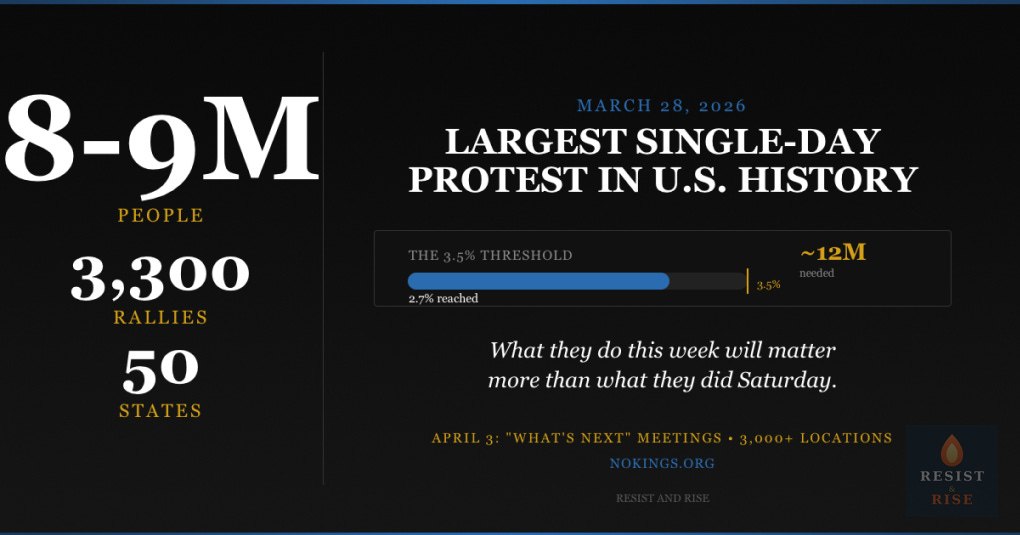
Eight to nine million people. 3,300 rallies. All 50 states. The No Kings protest on March 28, 2026, was the largest single-day demonstration in American history by any measure you want to use.
The number is real. And it is not the story.
The story is the question that every large protest movement eventually has to answer: what happens to those eight million people tomorrow?
Harvard political scientist Erica Chenoweth has spent decades studying what makes nonviolent resistance campaigns succeed or fail, analyzing 323 campaigns from 1900 to 2006. Her finding is that nonviolent campaigns succeeded in their objectives 53% of the time, compared to 26% for violent resistance. The decisive variables were not turnout numbers. They were tactical variations, such as boycotts, legal campaigns, and electoral organizing working alongside street protests, and sustained coalition breadth between mobilization days.
The No Kings movement has demonstrated geographic breadth. It has not yet demonstrated the local organizational infrastructure that separates transformative movements from memorable ones.
The next 30 days will tell us whether it can.
The 3.5% Rule—And Where the Movement Actually Stands
The 50501 Movement, which co-anchors No Kings alongside Indivisible, invokes a specific threshold on its website: the 3.5% rule. Chenoweth’s dataset shows that when a nonviolent campaign engages roughly 3.5% of a country’s population, it has historically never failed to produce significant political change.
For the United States, that is approximately 12 million people.
No Kings 3 drew 8–9 million. That is roughly 2.6 to 2.7% of the U.S. population, which is not at the threshold. More precisely, it reaches the threshold only if the people who showed up Saturday participate again, and in something other than a march.
Chenoweth’s research is specific about what “something else” means. The Civil Rights Movement, the domestic template that every resistance movement invokes, was not built on marches. It ran on the NAACP’s decades-long legal strategy, the Black church network’s physical infrastructure, HBCU student networks that produced trained organizers, and the economic boycotts such as Montgomery and Greensboro that created material leverage over power, not just moral pressure.
The marches were visible. The organizational infrastructure beneath them was the movement.
Two-Thirds of No Kings Is in Places Like Red Oak, Iowa
Two-thirds of No Kings 3 RSVPs came from outside major urban centers, including conservative-leaning states. Washington Post, March 28, 2026
Almost half of NoKings events took place in GOP strongholds.
Jenny Horner organized a rally in a small, conservative farming community called Red Oak, Iowa. She expected at least 50 people. In Highlands Ranch, Colorado, one of the Denver metro area’s most reliably Republican suburbs, local Democrats staged a protest in their own backyard. These are not outliers in No Kings 3. They are the majority.
This geographic reach is the movement’s most significant achievement and its sharpest organizational challenge.
Urban progressive enclaves have existing infrastructure: Indivisible chapters, union halls, and community organizing networks. Red Oak, Iowa, does not. Stateline, which has examined the infrastructure question more closely than most national outlets, put it plainly: “Democrats and other progressives are good at mobilizing people for large-scale protests, but they’ve been less successful than conservatives in recent years at building the kind of local infrastructure needed to effect sweeping policy changes.” Stateline, March 26, 2026
The Tea Party’s durability after 2010 came from building local chapter infrastructure in exactly these non-urban areas. This was achieved through school board campaigns, county party restructuring, and town halls in districts where the base was energized but unorganized. The No Kings movement is attempting to build the equivalent from the left in real time.
Whether it can do that in communities where progressive organizational density is thin is the central question the April meetings will start to answer.
What Indivisible Is Actually Building
The national organizations know the gap is real. On March 31, No Kings organizers are holding a national community call on “what comes next.” On April 3, over 3,000 local hosts will convene “What’s Next” organizing meetings across more than 80 events.
These aren’t debriefs. They’re the beginning of something harder.
Leah Greenberg, co-director of Indivisible, has publicly named what the movement is asking participants to commit to: ICE watch, monitoring and documenting enforcement actions in their own communities; mutual aid for immigrant families facing displacement; advocacy against the Iran war; and voter registration. Multiple outlets, March 2026
Four distinct organizational tracks. Different skill sets, different networks, different ongoing time commitments. Designed specifically to diversify tactics beyond protest days. This tactical variation is what Chenoweth’s research identifies as one of the key predictors of movement success.
“The people coming out will be asked to show up on an ongoing basis for ICE watch, for mutual aid, for support of immigrant communities, for advocacy against this illegal and catastrophic war, for voter registration and all the work of building power locally.” — Leah Greenberg, co-director, Indivisible, Stateline.org, March 26th, 2026
This is a harder ask than showing up for a march. It’s a weekly ask. It requires a local meeting place, a local organizer, and a local contact list. The question isn’t whether Indivisible has a theory of change; it does. The question is whether 3,000 April meeting hosts in communities like Red Oak have the organizational support to actually stand up those tracks or whether the meetings produce enthusiasm and no structure.
After the 2017 Women’s March, Indivisible launched more than 3,800 local groups in weeks. Those groups generated the town hall accountability pressure that blocked the first several attempts to repeal the Affordable Care Act. Many of those chapters dissolved by 2021. The “What’s Next” model being deployed now is, in part, an attempt to build organizational nodes that outlast a single legislative session.
Minneapolis: When Accountability Has a Name
The No Kings 3 flagship event was in Minneapolis. Not by accident.
Minnesota is where the movement’s most specific accountability demand lives. On January 7, 2026, ICE agent Jonathan Ross shot and killed Renée Good, a 37-year-old Minneapolis woman, during an immigration enforcement operation. On January 24, Customs and Border Protection officers shot and killed Alex Pretti, also 37 and an ICU nurse, while he was protesting the enforcement operation that had killed Good two weeks before. A third person, Julio Sosa-Celis, was shot and wounded in a related incident.
Two hundred thousand people gathered at the Minnesota State Capitol on March 28. Bruce Springsteen performed “Streets of Minneapolis,” a song he wrote about Good and Pretti. Governor Tim Walz stood at the steps and said, “We demand justice for Renee Good and Alex Pretti. We demand justice for every single person who was hurt or traumatized.” - The Minnesota Star Tribune, March 28, 2026
The federal government’s response has been to block accountability at every stage.
Deputy Attorney General Todd Blanche told Fox News Sunday that the DOJ would not open a criminal investigation into the agent who shot Renée Good, claiming it was unnecessary because “everybody can watch the videos and see that [Ross] got attacked with a car.” Minnesota officials dispute that account.
The DOJ opened a federal civil rights investigation into Alex Pretti’s killing in January. It declined to open one for Renée Good. - ProPublica
On March 24, four days before the march, the state of Minnesota, Hennepin County, and the Minnesota Bureau of Criminal Apprehension sued the Department of Justice and the Department of Homeland Security. The allegation is that the federal government is withholding investigative evidence in all three shootings to shield the agents involved. ProPublica; NPR, January 30, 2026; CBC News
The Minneapolis thread gives the No Kings movement something that most protest movements don’t have: named victims, a specific government agency, a legal process in a state court, and a governor willing to sue the federal government for access to the evidence. Successful resistance movements have always been anchored in specific accountability demands. This is the movement’s specific demand.
What It Means: The Organizational Audit
Apply Chenoweth’s criteria as a framework, and here is where the movement stands:
Turnout breadth: Strong. 8–9 million, all 50 states, two-thirds outside major urban centers. Approaching, but not at, the 3.5% threshold.
Tactical variation: In construction. The April organizing meetings are designed to launch ICE Watch, mutual aid, voter registration, and advocacy tracks alongside protest. Whether they succeed is the April test.
Local organizational infrastructure: Unproven in the places that matter most. The national organizations (Indivisible, 50501, and MoveOn) exist and have capacity. The local infrastructure in non-urban conservative-area communities does not yet exist in forms that can absorb and sustain new participants at scale.
Specific accountability demand: present and legally actionable. The Minnesota lawsuit is the movement’s sharpest point of contact with institutional power.
The Civil Rights Movement comparison is everywhere right now and almost always misapplied. What made the Civil Rights Movement succeed was not the Selma march. It was what happened in the months between the marches: the boycott organizers who kept Montgomery’s Black community unified for 381 days, the legal team building the cases that reached the Supreme Court, the SNCC organizers training students in direct action discipline, and the church networks maintaining social cohesion under state pressure.
The No Kings movement has the marches. The question over the next 30 days is whether it is also building on what happened between them.
What’s Next
March 31 (TODAY): No Kings national community call. Watch for specific commitments, public organizing toolkits, and indications of whether the April meeting structure will produce measurable conversion goals.
April 3: “What’s Next” organizing meetings at 3,000+ locations. First real conversion test: what do participants commit to? Are ICE watch networks and voter registration drives actually being launched at the local level?
April 8–11: National Action Network convention. Civil rights leaders will address voting rights rollbacks and economic impacts on communities of color. Watch for resolutions and campaign launches that can channel No Kings momentum into specific legislative fights.
April 20: FISA Section 702 reauthorization deadline. A bipartisan bill (Lee/Wyden/Davidson/Lofgren) would require warrants for data broker purchases ICE currently uses to sidestep Fourth Amendment protections. Hard deadline. Specific ask. A decision-maker with a voting record. This is the kind of time-pegged policy fight that converts protest participants into sustained civic actors. Contact your senator before this date via the EFF’s action tool: Electronic Frontier Foundation .
Minnesota accountability track: Watch for any court-ordered evidence disclosure in the Minnesota v. DOJ/DHS lawsuit. A ruling either way will reactivate the Good/Pretti accountability narrative at a national level.
Call to Action
Find a “What’s Next” organizing meeting near you at nokings.org—80+ events, all 50 states, starting April 3.
If you showed up Saturday, this is the meeting that determines whether that day produced something more than a number.
The movement’s theory of change depends on what you do this week.
Methods & Verification
All factual claims were cross-checked against primary sources, published reporting, and organizational records. Turnout figures (8–9 million; 3,300+ events) were confirmed across the Washington Post, NPR, ABC News, Britannica, and Wikipedia’s aggregated sourcing—all citing independent primary sources. The Minnesota lawsuit was confirmed by ProPublica, NPR, CBC, PBS, and Detroit News. Chenoweth’s 3.5% rule and 53%/26% success rates were confirmed via Harvard Kennedy School published research. Leah Greenberg quote sourced from multiple outlets reporting the same statement. Geographic composition data (two-thirds outside major urban centers) confirmed by the Washington Post, Stateline, and NPR.