


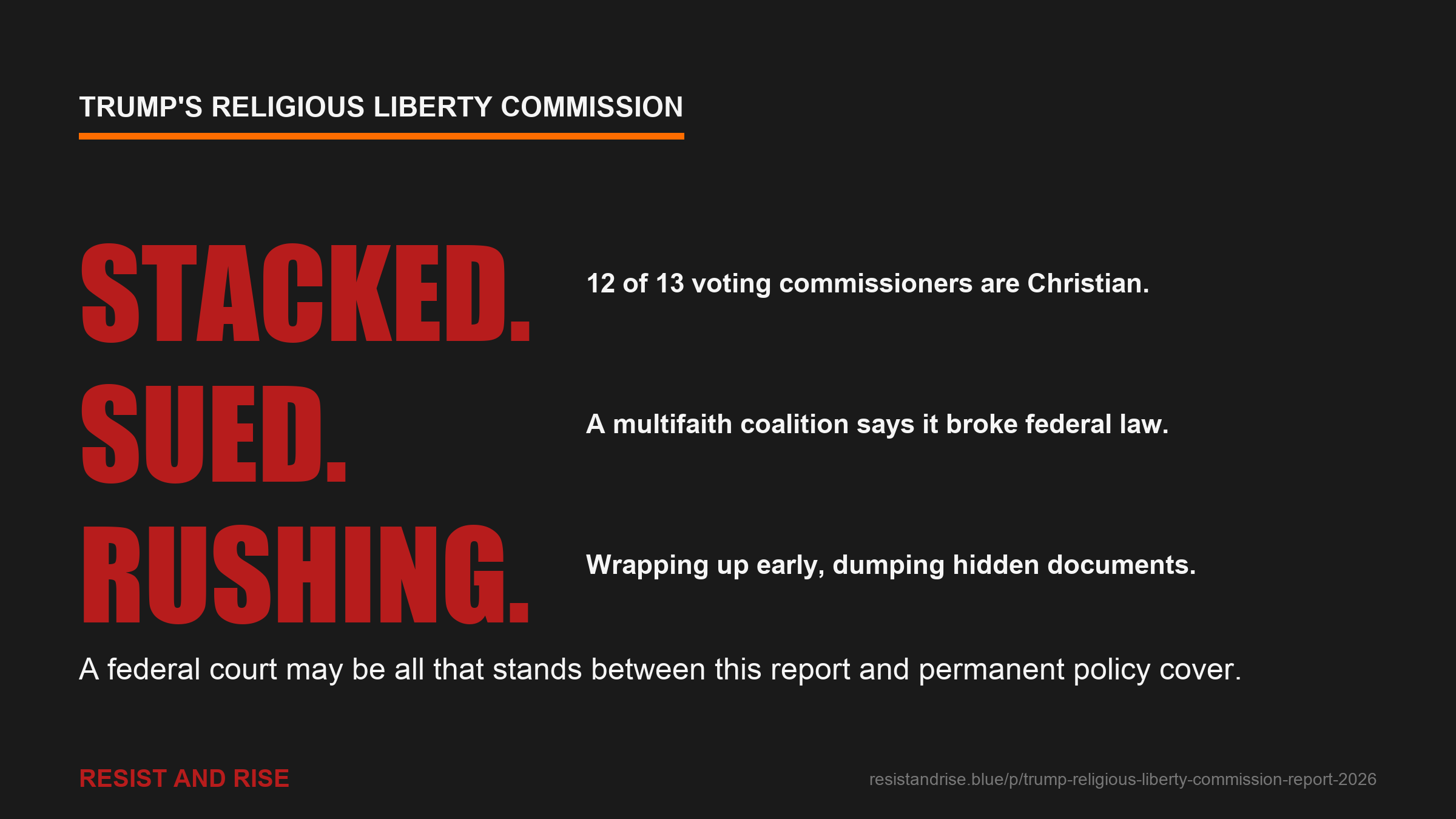
A presidential commission with zero Muslim, Hindu, Sikh, Buddhist, or nonreligious members is racing to publish a "religious liberty" report, and a federal court may be the only thing standing between that document and permanent policy cover.
Update—June 11, 2026: The preliminary injunction hearing was not postponed again past its rescheduled June 4, 2026, date, and the Southern District of New York held a follow-up telephone conference with the parties on June 8. As of June 9, the court docket reflects no ruling on the motion and lists the case as ongoing, and there is no public confirmation that the commission's final report has been released. The decision will be tracked on the (https://clearinghouse.net/case/47804/). Civil Rights Litigation Clearinghouse docket.*
A preliminary injunction hearing was originally scheduled for May 28, 2026, in the Southern District of New York and rescheduled to June 4, 2026. On one side: a multifaith coalition arguing that Trump's Religious Liberty Commission violated federal transparency and balance law. On the other: an administration that waited until the night before a court deadline to release documents it had been hiding for months.
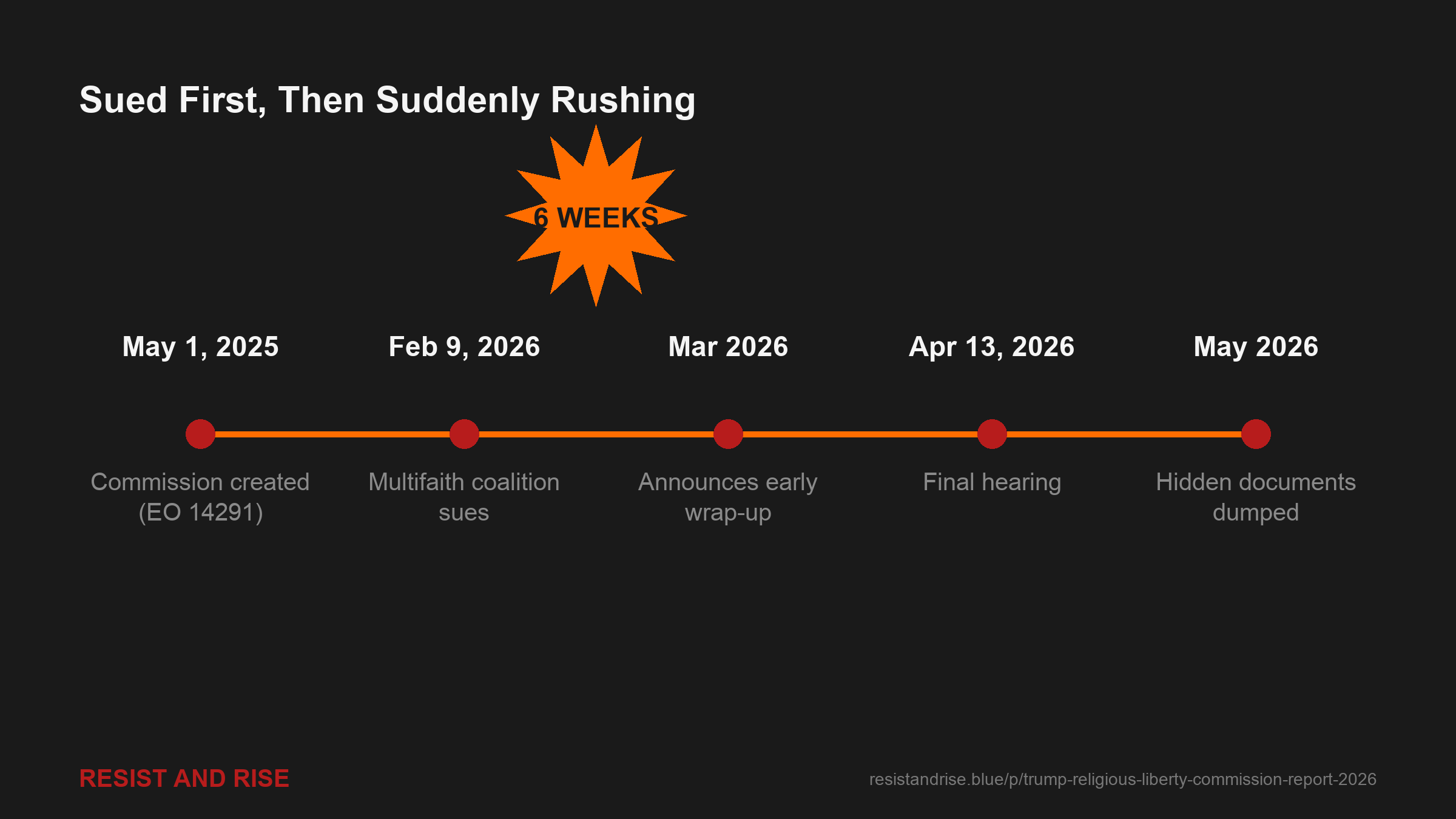
The commission, created by executive order on May 1, 2025, stacked with conservative Christian allies and scheduled to run through July 4, 2026, abruptly announced in March 2026 that it was wrapping up early and holding its final hearing. No reason was offered. But a federal lawsuit had been filed two months prior, and the timing wasn't subtle.
Whether that court issues a ruling before the final report drops and what that ruling says will determine whether this commission's output enters permanent circulation as the official conclusions of a "Presidential Commission on Religious Liberty," or gets labeled as what the plaintiffs say it actually is: the product of an unlawfully constituted body.
The stakes extend well beyond any injunction order.
What Is the Religious Liberty Commission?
President Trump established the Religious Liberty Commission by Executive Order 14291 on May 1, 2025. The commission is housed within the Department of Justice and tasked with identifying "threats to religious liberty" in the United States, then producing a final report with policy recommendations for the White House Faith Office and the Domestic Policy Council.
The appointed chair is Texas Lt. Gov. Dan Patrick. Former HUD Secretary Ben Carson serves as vice chair. The Attorney General, HUD Secretary, and White House Domestic Policy Assistant are all ex officio members, giving the commission direct connections to three federal agencies best positioned to act immediately on its recommendations.
The commission's term was set to expire on July 4, 2026. The White House specifically flagged the Semiquincentennial date as symbolic in its fact sheet.
Between June 2025 and April 2026, the commission held seven formal hearings, all at the Museum of the Bible in Washington, D.C.—DOJ Religious Liberty Commission. Then, in March 2026, roughly three months before its July 4, 2026, charter expiration, it announced it was wrapping up early and holding its final hearing.
No official explanation was given.
Presidential advisory commissions like this one have real consequences. Their reports are cited in executive orders, attached to federal regulatory filings, and invoked in DOJ litigation as evidence of expert-informed policy. The Federal Advisory Committee Act of 1972 (FACA) was enacted specifically to prevent advisory bodies from becoming captured instruments; it requires transparency, public access to documents, and, critically, fair balance in membership that reflects diverse viewpoints.
The Religious Liberty Commission is the most direct challenge to those guardrails in a generation.
Who's on It and Who's Conspicuously Not
Of the 13 official commissioners, 12 are Christian and one is an Orthodox Jewish rabbi, Rabbi Meir Soloveichik of Congregation Shearith Israel. No Muslim, Hindu, Sikh, Buddhist, or nonreligious American sits on the commission's voting body.
The commission has three advisory boards—religious leaders, lay leaders, and legal experts—that include a small number of non-Christian members. Advisory board members have no vote over the final report.
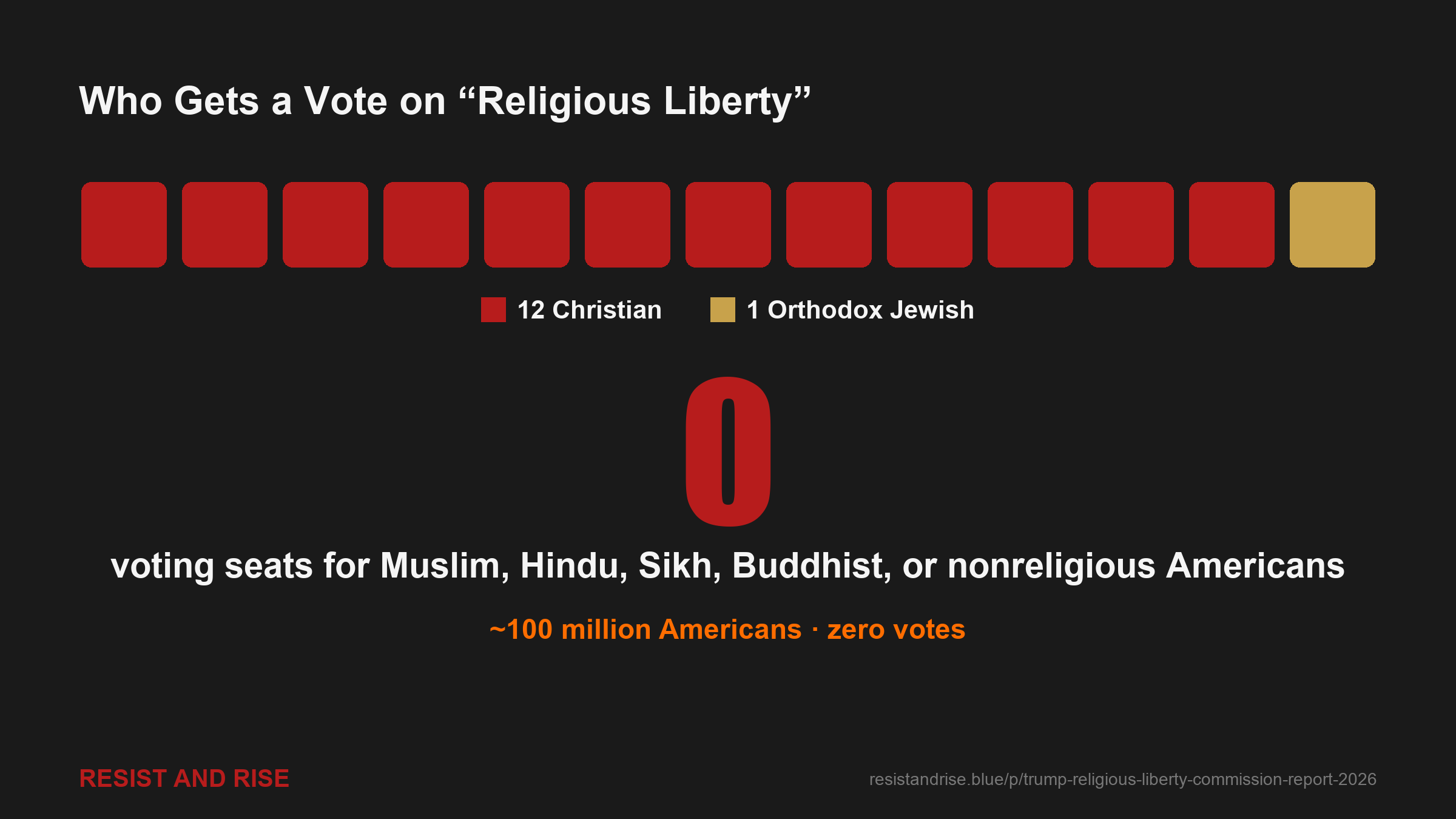
Consider who is voting:
Eric Metaxas, a conservative media figure, called Islam a "death cult" and wrote that Islam is "incompatible with American values" and is "NOT a religion" in February 2025—Media Matters for America, May 2025.
Franklin Graham, President and CEO of the Billy Graham Evangelistic Association, has described Islam as "evil" and "a religion of war," called for closing America to Muslim immigration, and opposed Duke University allowing a Friday call to prayer—BJC; CAIR.
Ryan T. Anderson, President of the Ethics and Public Policy Center, opposes same-sex marriage and gender-affirming care. EPPC has documented organizational connections to Project 2025, where it serves on the advisory board—EPPC.
Kelly Shackelford, President and CEO of First Liberty Institute, serves as the commission's built-in legal advocate. First Liberty represents clients in religious liberty cases expected to be cited in the commission's final report—First Liberty Institute. He is both advising the commission and preparing to use its output in litigation.
Paula White-Cain, Trump's White House Faith Office liaison, provides a direct channel from the commission to the Oval Office.
The commission also briefly included Carrie Prejean Boller until Dan Patrick ousted her in February 2026 after she used a hearing on antisemitism to defend a commentator promoting antisemitic conspiracy theories and quoted scripture attributing Jesus's death to Jews. She challenged Patrick's authority to remove her, asserting only Trump could do so—NBC News, February 2026; JTA, February 2026.
There is also Sameerah Munshi, the only Muslim woman in any formal role connected to the commission. She had accepted a seat on the advisory board "hesitantly," in her own words, because she believed someone needed to remain "a voice of reason" for American Muslims inside a body that would shape federal religious liberty policy.
She watched the antisemitism hearing. She watched the Boller removal. She resigned in March 2026, posting her resignation statement:
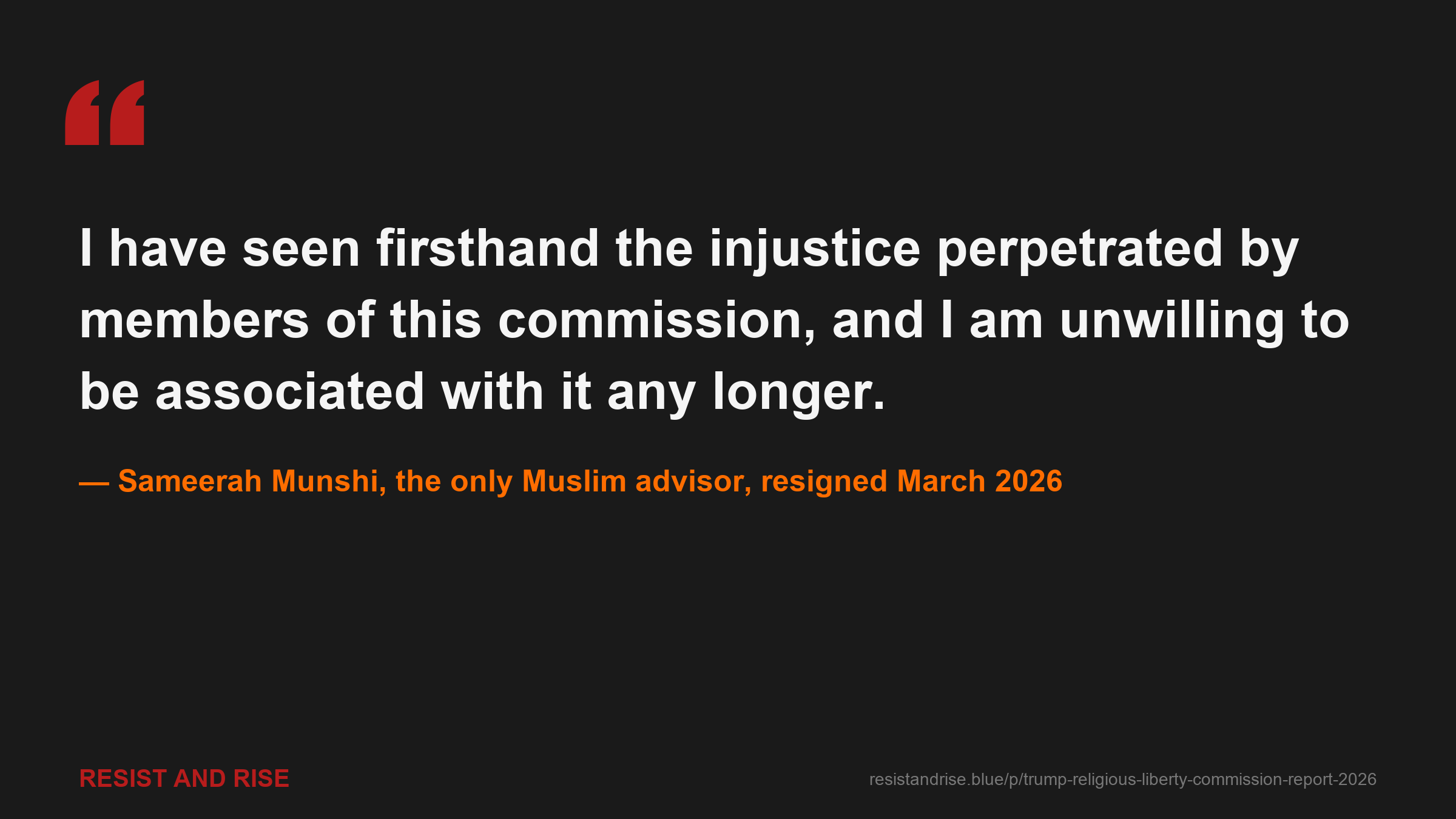
Her experience is not incidental to this story. It is the story. The commission did not include her. It used her. When she refused to continue, it lost even the pretense of representation—Newsweek, March 2026; JTA, March 13, 2026.
"Religious liberty means religious liberty for everyone, not just one faith community. By stacking this Religious Liberty Commission with a narrow set of voices and hiding the commission's work from the public eye, the Trump administration is evading the transparency and balance that federal law requires." — Ria Chakrabarty, Senior Policy Director, Hindus for Human Rights, February 2026
Pew Research Center data shows 1.2% of U.S. adults identify as Muslim, 1.1% as Buddhist, and 0.9% as Hindu, which is tens of millions of Americans. None sit on this commission. And according to ISPU's 2025 survey, 63% of Muslim Americans report experiencing religious discrimination, the highest rate of any religious group surveyed.
A body with zero representation from the communities most likely to face government-sanctioned discrimination is advising the president on how to protect religious liberty. That is not a balance problem. It is a design feature.
Why the Rush? The Report and the Lawsuit
On February 9, 2026, a multifaith coalition filed suit in the Southern District of New York: *Interfaith Alliance v. Trump*, 1:26-cv-01075. Plaintiffs include Interfaith Alliance, Muslims for Progressive Values, SALDEF (Sikh American Legal Defense and Education Fund), and Hindus for Human Rights. Legal representation comes from Democracy Forward and Americans United for Separation of Church and State.
The complaint alleges two FACA violations. First: the commission represents only conservative Judeo-Christian perspectives, while FACA requires advisory bodies to reflect diverse viewpoints. Second: the commission failed to post meeting transcripts publicly, agendas, hearing summaries, or witness testimony, all documents the law requires to be disclosed.
Six weeks after the lawsuit was filed, the commission announced it was wrapping up. On March 16, 2026, it set its final hearing for April 13. No reason was offered for the early conclusion—Democracy Forward, April 2, 2026.
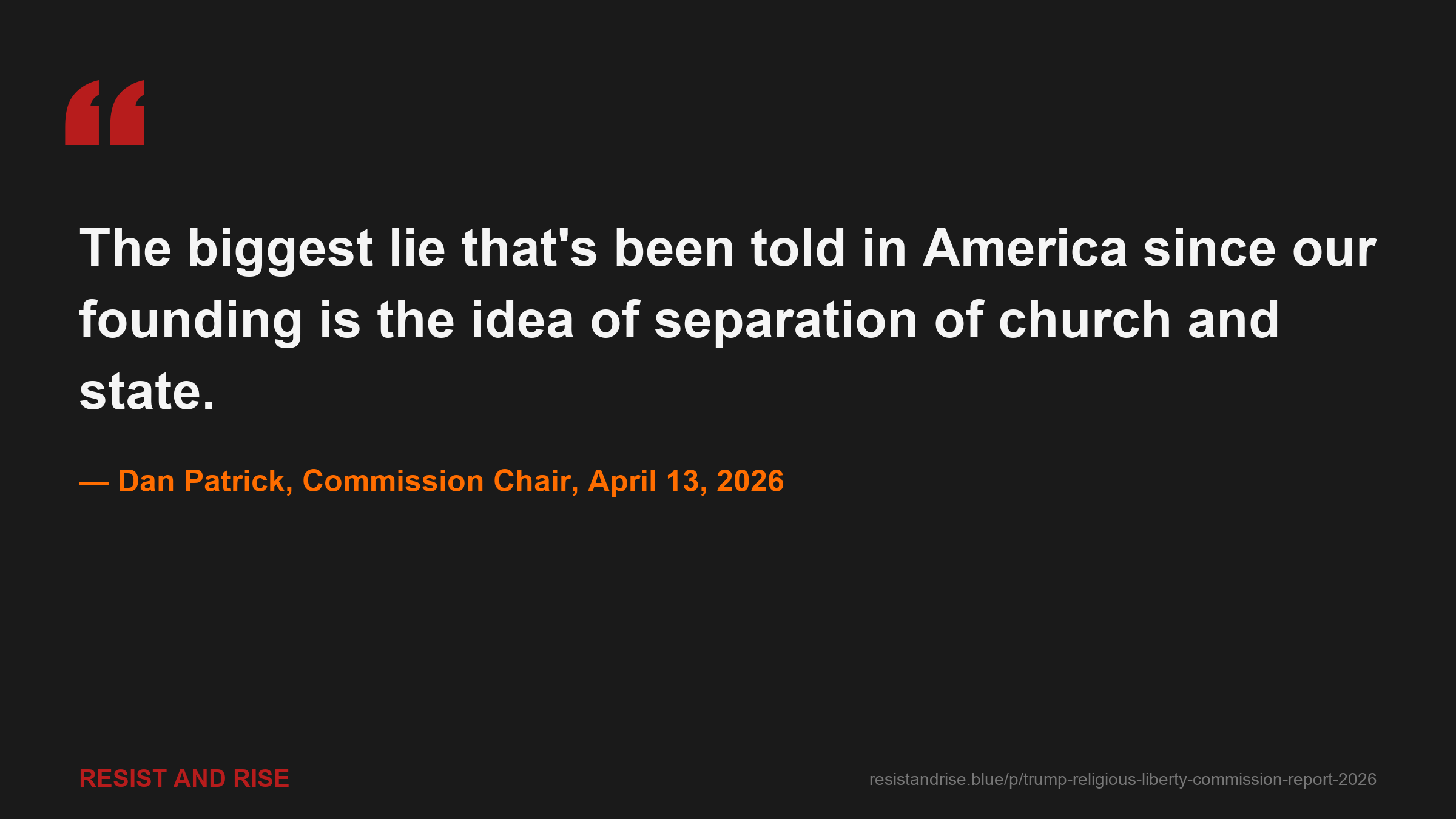
At that final hearing, Commission Chair Dan Patrick delivered the line that has since been quoted in every major outlet covering this story:
Then, on the night before a court-imposed litigation deadline in early May 2026, the government filed a notice with the SDNY that it had finally posted the previously withheld transcripts, hearing summaries, and meeting minutes. Democracy Forward called the release "a resounding concession by the government."
The pattern is legible: refuse to post documents, announce an abrupt early conclusion once sued, and release documents only under court deadline pressure. This is what an administration looks like when it knows its process cannot survive scrutiny.
The plaintiffs are seeking three things: a declaration that the commission violated FACA, an order requiring publication of all documents, and a requirement that any published report be labeled as coming from an unlawfully constituted commission. Even a denial of the full injunction leaves that labeling demand on the table as an accountability tool.
"As a Muslim American organization, we have seen firsthand how elevating a singular religion above others leads to the oppression and possible persecution of minority faiths." — Ani Zonneveld, President and Founder, Muslims for Progressive Values, February 9, 2026
What the Report Will Be Used For
Presidential commission reports do not carry the force of law. They carry something more durable: official government imprimatur. Reports like this get cited in executive orders, attached to regulatory filings, and invoked in DOJ litigation as evidence of an expert-informed policy basis. Once published, this one has no expiration date.
At the April 13 final hearing, commissioners presented their wish list for the report. According to the Philadelphia Inquirer / Religion News Service and Religion News Service, reported proposals include:
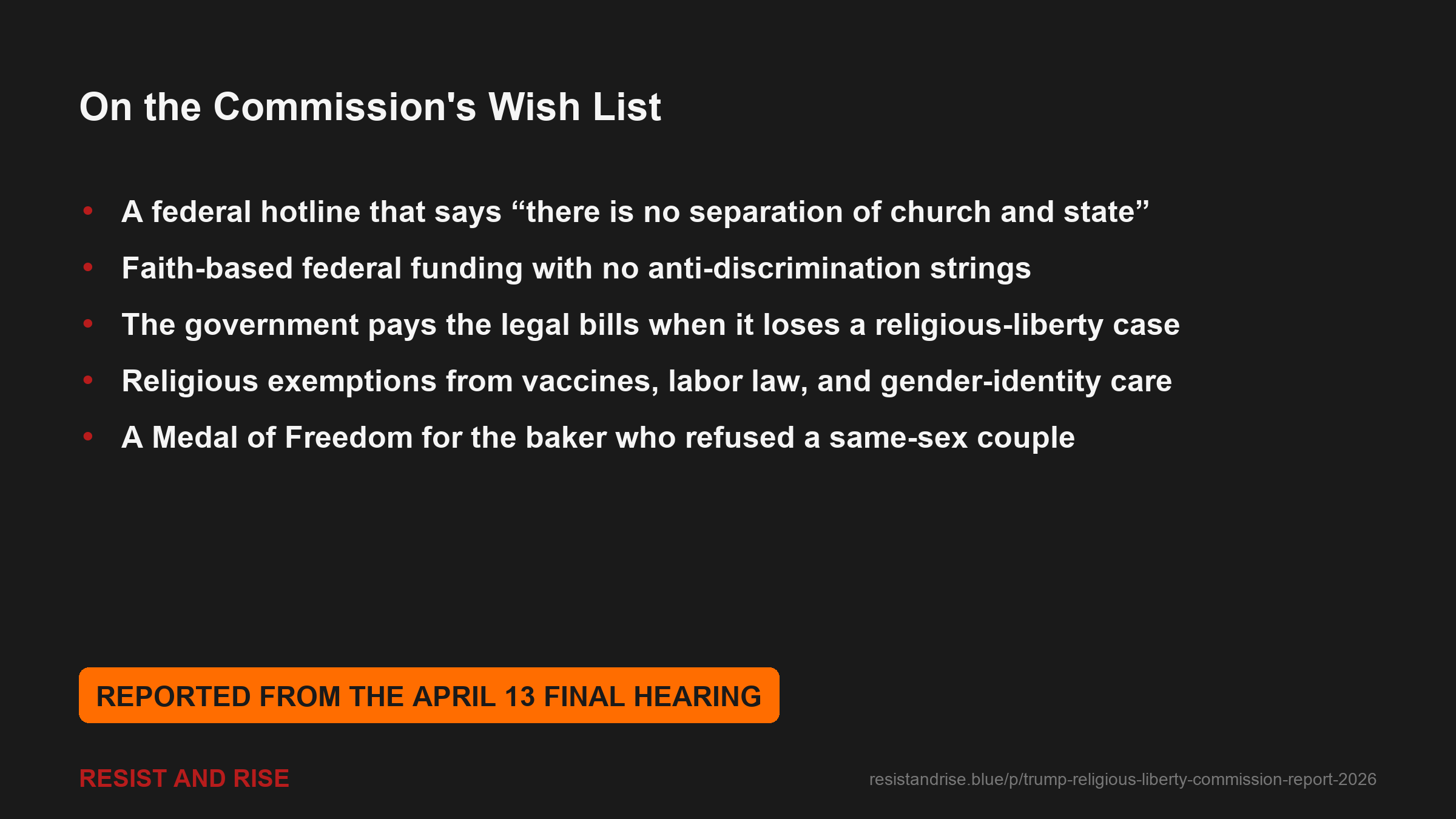
DOJ intervention on behalf of Amish parents fighting New York vaccine requirements and Catholic nuns challenging requirements to accommodate hospice patients' gender identities
Expanded religious expression in public schools mirroring the Department of Education's February 5, 2026, guidance on prayer in public schools, issued without public notice while commission hearings on the same topic were ongoing
These are not fringe asks. Similar bills advancing religious organizations' immunity from accountability have been proposed or advanced in Arizona, South Carolina, and Montana, aligned with the commission's philosophy, and have been flagged by the ACLU as part of a broader national pattern.
The Supreme Court helped too. Catholic Charities Bureau, Inc. v. Wisconsin and Mahmoud v. Taylor both produced religious liberty victories in 2025, creating favorable litigation terrain for the commission's proposed exemptions.
By the time the final report lands, a coordinated infrastructure of federal guidance, state legislation, and favorable Supreme Court precedent will already be in place. The report is not the beginning of this agenda. It is the ratification document.
What It Means
The commission's name does a lot of heavy lifting. "Religious liberty" sounds universal. The commission is not.
Twelve of 13 voting commissioners are Christian. None represent the 100 million Americans who are Muslim, Hindu, Sikh, Buddhist, nonreligious, or belong to faiths not represented in a Judeo-Christian frame. The plaintiffs' complaint on file in federal court alleges that all 13 commissioners collectively affirm the United States was founded as a "Judeo-Christian nation" which is a historically contested and legally consequential claim.
What's been built is a body with a direct pipeline to the White House and DOJ, producing a report on religious freedom for all Americans that was written by representatives of one religious tradition, insulated from public scrutiny, and rushed to completion once a federal lawsuit threatened to expose what the process actually looked like.
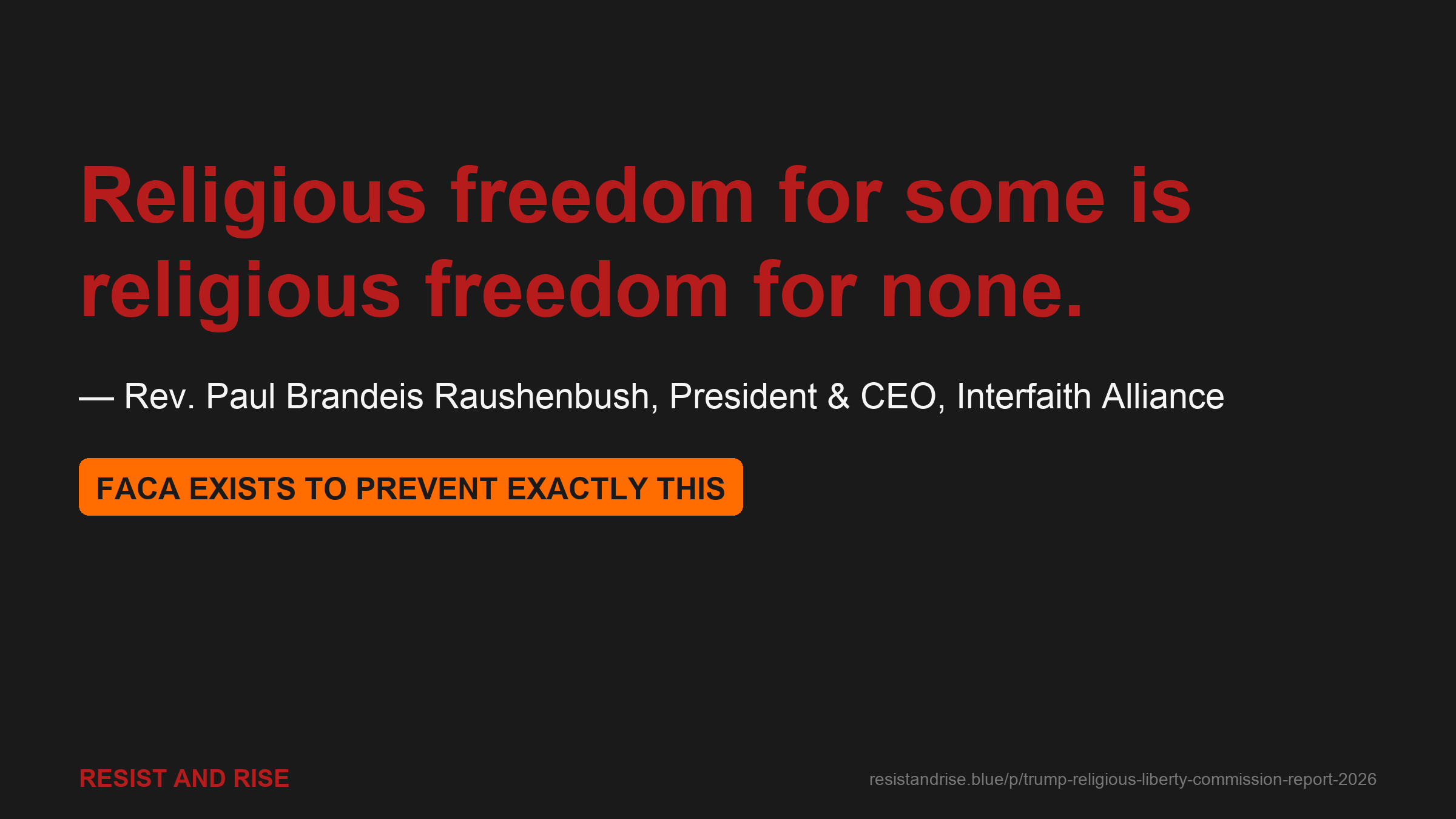
The Federal Advisory Committee Act exists precisely to prevent this. Whether the Southern District of New York enforces it is now one of the most consequential religious liberty questions of this moment, and "religious liberty" here means liberty for every American this commission was never designed to represent.
What's Next
SDNY ruling on the preliminary injunction. The preliminary injunction hearing was scheduled for May 28, 2026, and rescheduled to June 4, 2026, which proceeded without further postponement; the court held a telephone conference with the parties on June 8, and as of June 9, 2026, no ruling had been issued. A ruling blocking the report's publication would be immediate and consequential. A denial would accelerate the report's release and make the labeling demand by requiring the report to identify itself as coming from an unlawfully constituted body, which is the central remaining ask. Track the Civil Rights Litigation Clearinghouse docket for updates.
Publication of the final report. The commission announced publication on or around May 1, 2026; as of early June, it had not publicly appeared. When it drops, watch which federal agencies cite it in rule-making filings within 60 days. DOJ, the Department of Education, and HHS are the most likely early adopters.
Commission extension past July 4, 2026. Trump retains authority to extend the commission by executive order past its semiquincentennial expiration date. If he does this, particularly after a court ruling, it signals the administration intends to use this body as a continuing governance tool, not a one-time advisory commission.
State-level immunity bills. Watch for floor votes in Arizona, South Carolina, and Montana this summer. Any legislation citing the commission's report as a factual basis would demonstrate the downstream infrastructure functioning exactly as designed.
What You Can Do
Follow the lawsuit in real time. Americans United for Separation of Church and State maintains a dedicated tracking hub at au.org/religious-liberty-commission with case filings, action alerts, and ongoing developments. The full docket is publicly available at the Civil Rights Litigation Clearinghouse.
Contact your senators and representatives now, before the report lands. Find your senators and representatives. A report circulated as official government findings carries more political weight the longer it sits unchallenged. Congressional oversight hearings are one check that does not require a court ruling.
Support the organizations on the front lines. Democracy Forward, Americans United, Interfaith Alliance, and Hindus for Human Rights are litigating and organizing simultaneously. Their work is the mechanism by which the FACA law actually gets enforced.
Watch your state legislature. Bills advancing blanket religious immunity for organizations have been proposed in Arizona, South Carolina, and Montana in alignment with the commission's philosophy. If you live in those states, this is your most immediate action point.
Methods & Verification: This article draws on primary government sources — including Executive Order 14291 (Federal Register), White House fact sheets, DOJ commissioner listings, and the full complaint filed in Interfaith Alliance v. Trump (SDNY 1:26-cv-01075) — along with Democracy Forward press releases, Americans United case filings, and original reporting from Religion News Service, Philadelphia Inquirer, JTA, NBC News, and Newsweek. All quotes are sourced to their original publication with full attribution. Commission composition data was verified against the DOJ's official commissioner listing and confirmed in the federal complaint. The SDNY preliminary injunction ruling was pending as of publication.
Sources
Wild Hunt — Pagan and non-Christian community perspectives on the lawsuit, February 2026
Berkley Center, Georgetown University — academic analysis of representation concerns and First Amendment implications
Americans United case page — full case filings and litigation updates
Pew Research Center Religious Landscape Study, 2023–24 — religious demographics cited in membership analysis
The real threat to religious liberty is the so called 'Christian' nationalists...