


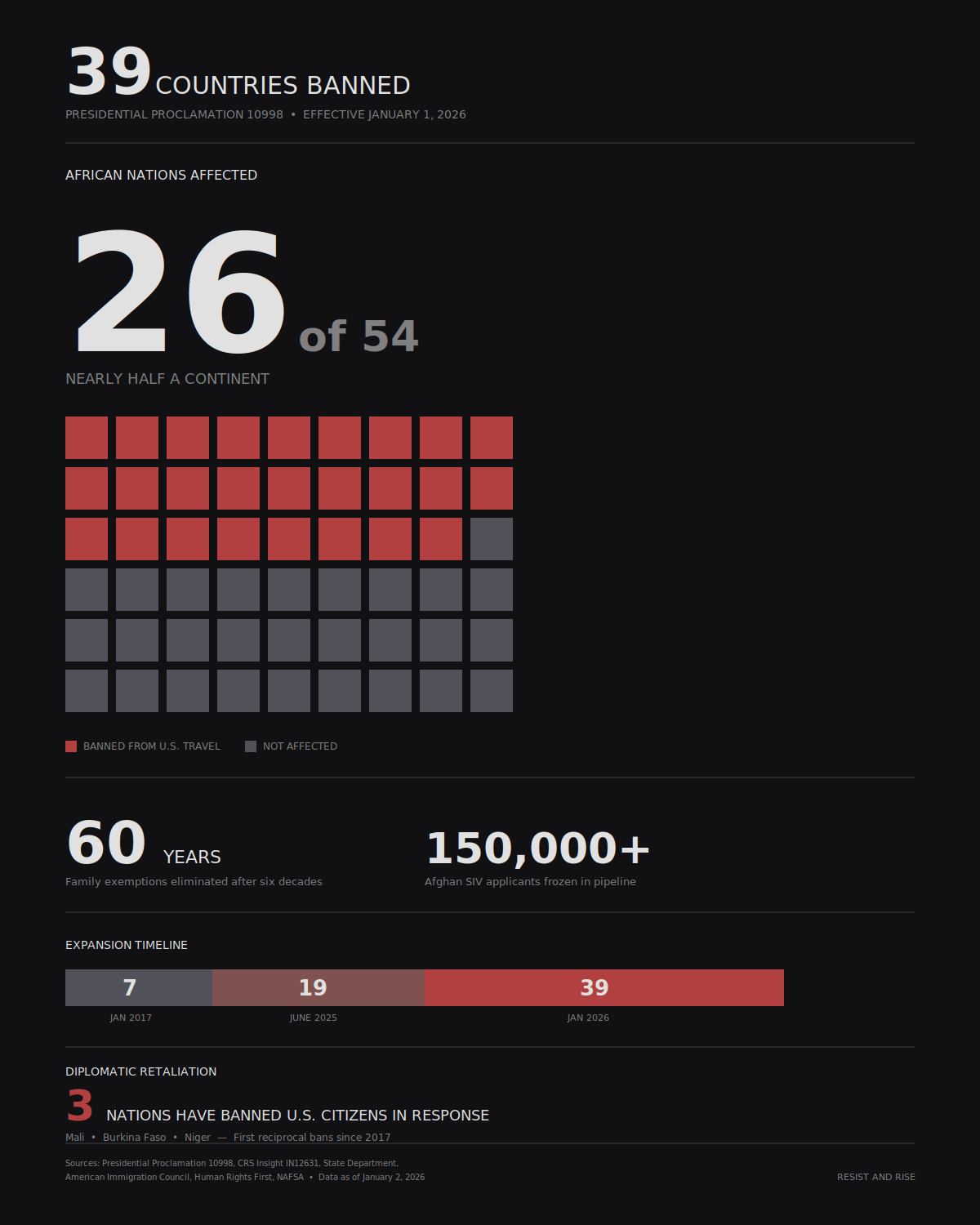
While America celebrated New Year’s Eve, the largest expansion of U.S. travel restrictions since 2017 quietly took effect at midnight—doubling banned countries to 39 and eliminating family exemptions that have existed for 60 years.
The Holiday News Dump
At 12:01 AM Eastern yesterday, January 1, 2026, as champagne corks popped across the country, the Trump administration’s expanded travel ban took effect. The December 16 proclamation, signed exactly 15 days before implementation, doubled the number of banned countries from 19 to 39 and removed critical exemptions for immediate family members of U.S. citizens.
You probably didn’t see it in your news feed. Neither did most Americans. That wasn’t an accident.
The timing follows a documented pattern. The original “Muslim ban” of January 27, 2017, was issued on a Friday evening, creating chaos at airports nationwide before advocacy groups could mobilize. The December proclamation exploited an even more effective shield: the holiday news cycle. Congressional oversight is dormant. Newsrooms are running skeleton crews. Media attention diffused by year-end retrospectives.
The result? The most sweeping expansion of immigration restrictions in nearly a decade slipped into effect with barely a headline. The mainstream media’s near-total silence amounts to complicity by omission.
What Changed Yesterday
From 19 to 39 Countries: The Full Expansion
The December proclamation continues the full suspension of entry for nationals of 19 countries, adding seven more: Burkina Faso, Laos, Mali, Niger, Sierra Leone, South Sudan, and Syria, plus individuals traveling on Palestinian Authority documents.
Twenty additional countries face “partial suspension,” barring immigrant visas and suspending visitor, student, and exchange visas. The full ban covers nearly all nonimmigrant categories typically encountered in higher education and business: B visitors, F and M students, J exchange visitors, and H-1B and O-1 workers.
Twenty-six of the 54 nations on the African continent are now banned from travel to the United States. Nearly half a continent. Human rights organizations immediately flagged the geographic concentration as racially motivated.
“This racist proclamation is a sweeping act of collective punishment. It stigmatizes entire nationalities, relies on fear and generalizations, and doubles down on policies that have already caused enormous human suffering.”
— Uzra Zeya, President and CEO, Human Rights First (December 17, 2025)
The Removed Exemptions That Matter Most
The expansion isn’t just about more countries. It’s about what’s been taken away.
Compared to the June proclamation, the December version removes categorical exceptions for immediate relatives of U.S. citizens, adoptions, and Afghan Special Immigrant Visas.
For 60 years, since the Immigration and Nationality Act of 1965 replaced the discriminatory national-origins quota system, family reunification has been a cornerstone of U.S. immigration policy. Under the June ban, U.S. citizens could still sponsor their spouses, parents, and children under 21 from banned countries through the immediate relative visa category.
That’s over.
These families must now seek case-by-case “national interest” waivers—a discretionary process with no clear application pathway and historically low approval rates. This echoes historical patterns of targeting immigrant communities that should alarm anyone familiar with America’s darker chapters.
The Trump administration’s justification, from the proclamation itself: “Familial ties can serve… as unique vectors for fraudulent, criminal, or even terrorist activity.”
The Human Cost: Families Torn Apart
Wisconsin’s Hmong Community Feels the Blow
Bee Van Her still remembers fleeing Laos with his family in 1975 after the Vietnam War. Now Executive Director of the Hmong American Center in Wausau, Wisconsin, he watches the travel ban tear apart the community he helped build.
Wisconsin is home to more than 70,000 Hmong people. Many have relatives still in Laos, people they visit for Hmong New Year celebrations, funerals, and family gatherings. With Laos now on the full suspension list, those connections face indefinite severance.
“We’re family oriented; we stay connected, even though we’re overseas where everybody’s in a different country, we stay connected as much as we can. So that’s tearing apart, for sure, the family relationships.”
— Bee Van Her, Executive Director, Hmong American Center (WKOW, December 29, 2025)
The ban hits especially hard for the approximately 200 Hmong-Lao veterans still living in Wisconsin, allies who fought alongside U.S. forces during the Secret War and have spent 50 years seeking recognition as American veterans.
Afghan Allies Betrayed—Again
The December proclamation eliminates the categorical exemption for Afghan Special Immigrant Visas. The betrayal cuts to the core of America’s broken promises.
Congress created Afghan SIVs to provide a pathway to safety for Afghans who risked their lives working alongside U.S. military and diplomatic personnel during America’s 20-year war. These interpreters, translators, and support staff often faced Taliban death threats specifically because of their service to the United States.
Now they’re subject to the same ban as nationals from countries the administration claims pose security threats despite being among the most thoroughly vetted individuals in the entire U.S. immigration system.
“Eliminating these protections is not a technical adjustment but a deliberate escalation with immediate humanitarian consequences. Expanding the list of affected countries punishes civilians for circumstances beyond their control.”
— Sean VanDiver, President, AfghanEvac (December 16, 2025)
An estimated 150,000+ Afghan SIV applicants and their family members remained in the pipeline as of November 2025, many still in Afghanistan or third countries, awaiting processing that has now been frozen. As enforcement mechanisms expand, including the Palantir-powered ImmigrationOS system and the broader deportation surveillance apparatus, these allies face not just bureaucratic limbo but active danger.
The Diplomatic Fallout: Retaliation Has Begun
The ban isn’t just affecting individuals. It’s fracturing international relationships.
Mali and Burkina Faso announced reciprocal visa bans on U.S. citizens within days of the December proclamation. Both governments emphasized that the new measures apply “equivalent visa measures” and cited “the principle of reciprocity.”
These are the first such countermeasures since the travel ban policy began in 2017. The African Union, representing 55 member states, issued a formal statement expressing concern about the “potential negative impact” on educational exchanges, commercial engagement, and diplomatic relations built over decades.
“Trump’s ban will likely make relations between the U.S. and various African countries ‘incoherent, unpredictable, and challenging.’ The measure also reduces prospects for cooperation and may push some governments to look elsewhere to build strong partnerships.”
— Beverly Ochieng, Analyst, Control Risks Group, Dakar (Al Jazeera, December 31, 2025)
The World Cup Paradox
The United States, Canada, and Mexico will co-host the 2026 FIFA World Cup—the largest sporting event in the world. Haiti, Iran, Senegal, and Côte d’Ivoire have all qualified. Their fans are now banned from attending.
B-2 tourist visas, the category fans would need to enter the U.S., are prohibited for nationals of all four countries.
The proclamation exempts “athletes, coaches, support staff, and immediate relatives traveling for the World Cup.” It does not exempt fans. Senegal and Côte d’Ivoire supporters who don’t already have valid U.S. visas cannot obtain them. National teams may compete before empty supporter sections.
Haiti qualified for the World Cup for the first time in over 50 years. Most fans from the island will not be able to watch their team play in the United States. The Trump administration recently ordered an end to Temporary Protected Status (TPS) for Haitians, meaning 340,000 Haitians currently living in the country will lose legal protection and work authorization by February 3, 2026.
The administration is hosting the world while telling much of the world they’re not welcome.
The Constitutional Question
Secretary Noem’s rhetoric may have handed legal challengers a gift.
On December 1, 2025, Noem posted, on X: “I am recommending a full travel ban on every damn country that’s been flooding our nation with killers, leeches, and entitlement junkies.”
Immigration law experts immediately flagged the statement.
“Well, this is pretty much exhibit number one re: unconstitutional animus in any lawsuit against an impending travel ban.”
— Aaron Reichlin-Melnick, Senior Fellow, American Immigration Council (NBC News, December 2, 2025)
In Trump v. Hawaii (2018), the Supreme Court upheld the travel ban 5-4, deferring to executive national security determinations. But documented “animus” in official statements could distinguish future legal challenges. The question is whether any court will have the courage to act.
What It Means
This isn’t just about immigration policy. It’s about who America claims to be.
For 60 years, the principle that “families belong together” has been codified in immigration law. The December proclamation breaks that commitment not just for strangers, but for the immediate family members of American citizens.
The administration argues this prevents “familial ties” from becoming security threats. The real message is simpler: some families don’t count. Some connections don’t matter. Some people, based on where they were born, are presumptively dangerous.
The processing freeze at USCIS compounds the damage. In late November 2025, USCIS implemented a blanket pause on the adjudication of all immigration benefits for foreign nationals subject to the travel ban, immigrant and nonimmigrant worker petitions, green card applications, and even citizenship oath ceremonies.
People who followed every rule, filed every form, and waited years in line are now frozen in bureaucratic limbo.
What’s Next
• 180-Day Review Period (~June 15, 2026): The proclamation mandates periodic review of whether restrictions should be continued, modified, or terminated. Watch for countries removed or added.
• World Cup Visa Crisis (March–May 2026): As FIFA finalizes logistics and ticket holders from banned countries face visa impossibility, expect diplomatic pressure and potential emergency exemptions.
• Legal Challenges (January–February 2026): Immigration advocacy organizations are assessing the December proclamation for constitutional vulnerabilities. Monitor federal court dockets in the Ninth Circuit and D.C. Circuit for emergency filings.
• Additional Retaliatory Actions: Watch for further African nations implementing reciprocal measures, collective African Union action, and impacts on U.S. business interests across the continent.
What You Can Do
Know Your Rights
If you or someone you know is affected, consult these resources immediately:
• IRAP Legal Information—Multi-language guides on recent U.S. policy changes
• American Immigration Council Analysis
• NAFSA Regulatory Information
• Stop AAPI Hate Know Your Rights
National Advocacy Organizations
These organizations are providing direct support and fighting back:
• International Refugee Assistance Project (IRAP)—Free legal services for refugees and displaced people
• AfghanEvac—Supporting Afghan allies with evacuation and resettlement
• No One Left Behind—Advocacy for Afghan and Iraqi SIV Holders
• Human Rights First—Legal advocacy and policy analysis
• American Immigration Council—Research and litigation
• ACLU Immigrants’ Rights Project—Constitutional challenges and legal defense
• CAIR National—Legal assistance and community support
• National Immigration Law Center—Legal advocacy and policy analysis
• Black Alliance for Just Immigration (BAJI)—Advocacy for Black immigrants
Florida-Specific Resources
For affected community members in Florida:
• Americans for Immigrant Justice (AI Justice)—Miami-based nonprofit law firm serving 145,000+ individuals from 160 countries
• Florida Immigrant Coalition (FLIC)—Statewide grassroots movement for immigrant rights
• Florida RAISE Alliance—Rapid Response Alliance for Immigrant Safety and Empowerment
• Florida Justice for Our Neighbors—Free immigration legal services for low-income immigrants
• Catholic Legal Services Archdiocese of Miami—Immigration legal aid
• FIRC (Florida Immigrant Rights Center)—Deportation defense in the Florida Panhandle, South Georgia, and South Alabama
• WeCount!—South Florida immigrant worker organization
• Keys Immigrant Coalition—Monroe County immigration advocacy and support
• AFSC Florida—Immigration legal services and Know Your Rights education
• Immigration Advocates Network Directory for Florida—Comprehensive list of Florida legal service providers
Support the Movement
Community resistance is building. Learn how grassroots organizing is challenging these policies and find ways to contribute to the fight.
Contact Your Representatives
Demand congressional oversight. The December 16 announcement received virtually no congressional scrutiny during the holiday recess. Your representatives need to hear that this matters, especially before the 180-day review deadline.
Share This Information
Most Americans have no idea this happened yesterday. The mainstream media failed to cover it. Share this article with someone who needs to understand what just took effect.
⚡ BREAKING: Niger Joins Retaliatory Bans
Updated January 2, 2026
As this article goes to publication, Niger has implemented reciprocal visa bans on U.S. citizens, joining Mali and Burkina Faso in the escalating diplomatic fallout.
Three African nations have now closed their doors to Americans in direct response to Trump’s travel ban, an unprecedented level of retaliation that signals a fundamental shift in U.S.-Africa relations.
The pattern is accelerating. What began as a unilateral U.S. policy is triggering a cascade of reciprocal restrictions that could affect American travelers, businesses, diplomats, and NGO workers across the Sahel region.
We will continue monitoring developments and update as additional nations respond.
Methods & Verification
All factual claims were cross-checked against primary government sources (Presidential Proclamation 10998, CRS Insight IN12631, State Department alerts), contemporaneous news reporting from multiple outlets, and analysis from credentialed immigration policy organizations. Quotes were verified against original sources or confirmed through at least two independent news reports. Statistical data on affected visas and countries were corroborated between government sources and independent analysis from the American Immigration Council and NAFSA.
If you enjoyed this post and want to support Resist and Rise, I can always enjoy a good cup of coffee.
Subscribe to Resist and Rise for continued coverage as this policy evolves. The courts may act. Communities will organize. And we’ll be here documenting every step.
When the mainstream media goes silent, independent journalism becomes essential.