


ICE spent $5 million on a tool that lets agents draw a digital fence around your neighborhood, identify every phone inside it, and follow those devices home—all without a warrant.
You walked to the corner store last Tuesday. You didn’t cross a border, attend a protest, or break a single law. But if you live within a few blocks of a neighborhood that ICE has targeted, your phone’s location was captured, logged, and stored by a surveillance tool called Webloc. This is all without a warrant, without your knowledge, and without any legal obligation to tell you it happened.
This isn’t hypothetical. This is the surveillance infrastructure your government has already built. And it is pointed at everyone.
Your Phone Is Already in the Net
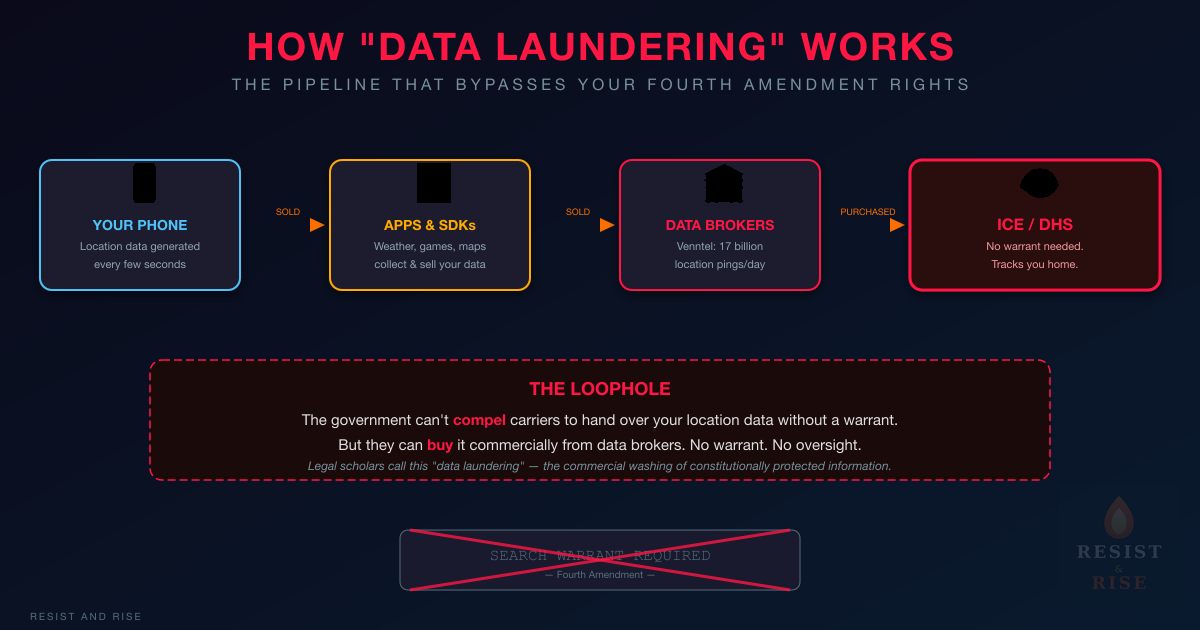
Every smartphone in America continuously broadcasts location data through GPS, Wi-Fi, Bluetooth, and cellular connections. Thousands of apps, including your weather widget, your fitness tracker, and that game you downloaded and forgot about. They all harvest this data and sell it to brokers who aggregate it into databases containing billions of daily signals.
ICE has been purchasing this commercially available location data since at least 2017, bypassing warrant requirements that would apply if agents obtained the same information directly from your phone carrier.
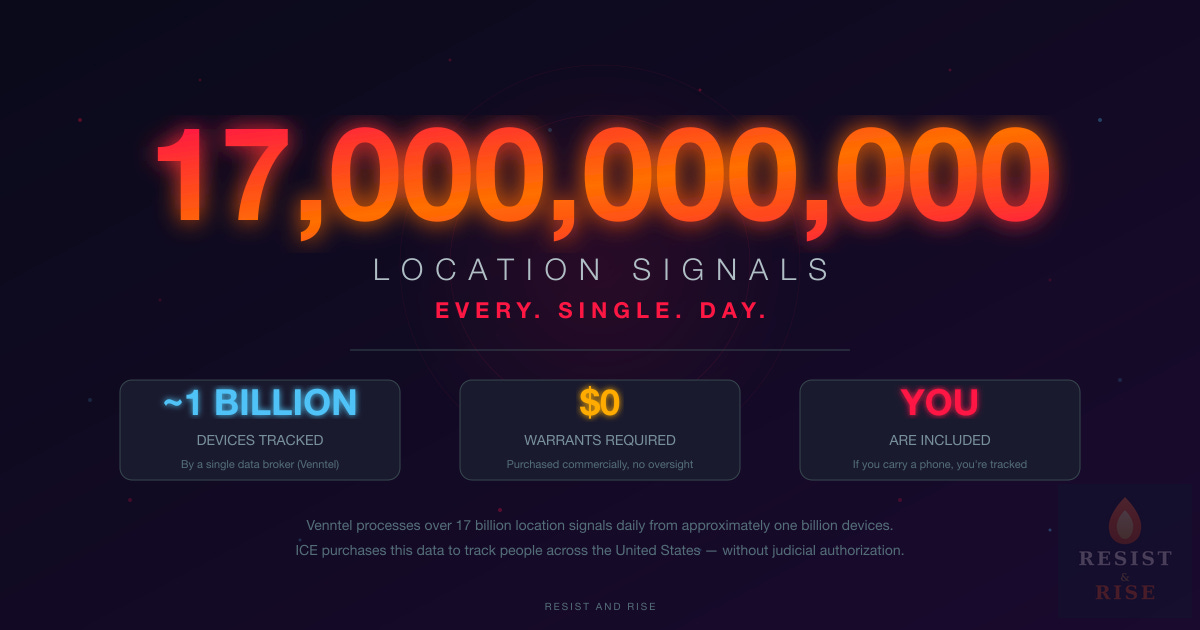
The scale is staggering. Venntel, a subsidiary of Gravy Analytics that has sold raw location data to ICE, CBP, and the FBI, processes well over 17 billion signals from approximately one billion mobile devices daily, according to an FTC complaint filed in December 2024. The FTC found that Gravy Analytics and Venntel had “unlawfully” sold sensitive location data tracking consumers to medical facilities, places of worship, and political events.
The FTC finalized an order in January 2025 prohibiting these companies from selling sensitive location data. The broader commercial data market remains largely unregulated. The pipeline is still flowing.
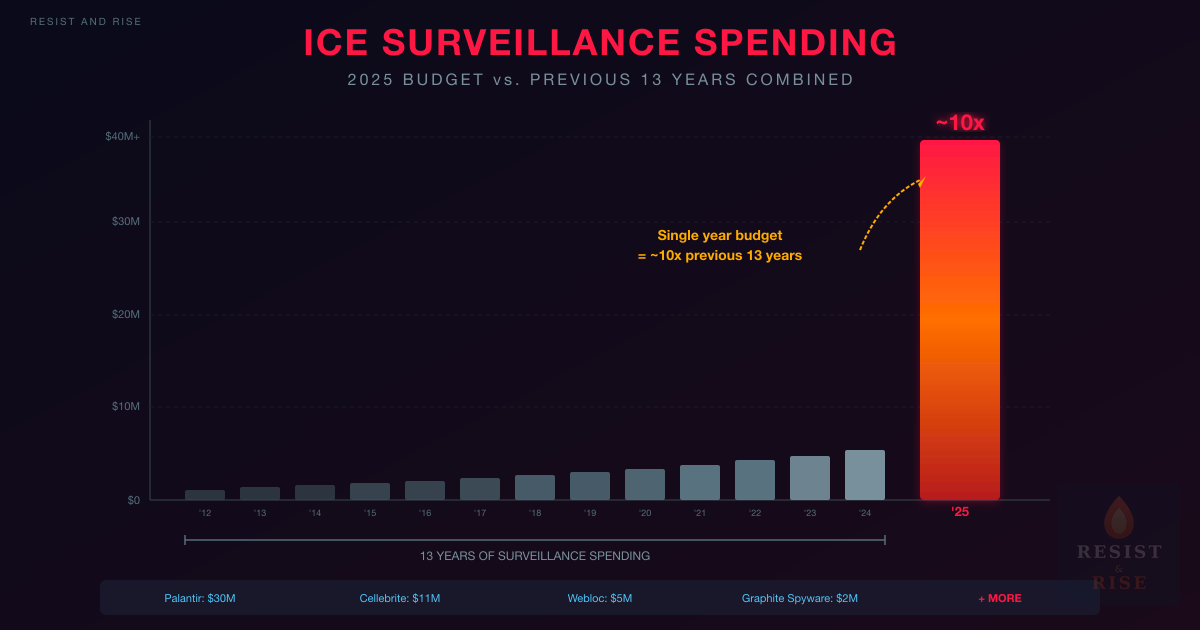
Then, in January 2026, the Electronic Frontier Foundation published a detailed analysis warning that “ICE is going on a surveillance shopping spree,” with a fiscal year 2025 budget of $28.7 billion. That’s roughly ten times the agency’s total surveillance expenditures over the prior thirteen years.
Ten times. In a single budget cycle.
The Washington Post reported in February 2026 that federal immigration officers are “newly equipped with state-of-the-art surveillance technologies” after legislation transformed ICE into “the country’s most highly funded law enforcement agency,” with purchases including “biometric trackers, mobile phone location databases, spyware, and drones.”
The $5 Million Digital Fence
So what exactly did ICE buy?
The tool is called Webloc. It is a geofencing surveillance module within a broader platform called Tangles, both products of Cobwebs Technologies, an Israeli surveillance firm. They merged into Nebraska-based PenLink in July 2023, when both companies were acquired by private equity firm Spire Capital in a $200 million deal. Since 2021, ICE has spent over $5 million on surveillance tools made by Cobwebs/PenLink.
In September 2025, 404 Media obtained documents showing exactly how it works. Webloc lets agents draw virtual perimeters, geofences, around any geographic area. A single city block. A church parking lot. A school zone. An entire neighborhood.
The tool then identifies every mobile phone present within that zone, tracks those devices and their owners over time, and follows them from workplaces to homes.
No warrant. No probable cause. No individualized suspicion of any kind.
An internal ICE legal analysis shared with 404 Media concluded that commercial location data acquired through Webloc “can be queried without a warrant.” The agency’s own lawyers signed off.
Senator Ron Wyden (D-OR) put it plainly in a statement to 404 Media: “Every American should be concerned that Trump’s hand-picked security force is once again buying and using location data without a warrant.”
Tangles, the social media surveillance component, makes it worse. According to the EFF, it scrapes data from the open web, deep web, and dark web, building dossiers. This is done by linking together a person’s posting history, location data, social graph, and photos, including those of friends and family.
Webloc and Tangles don’t operate in isolation. They are pieces of a much larger surveillance machine.
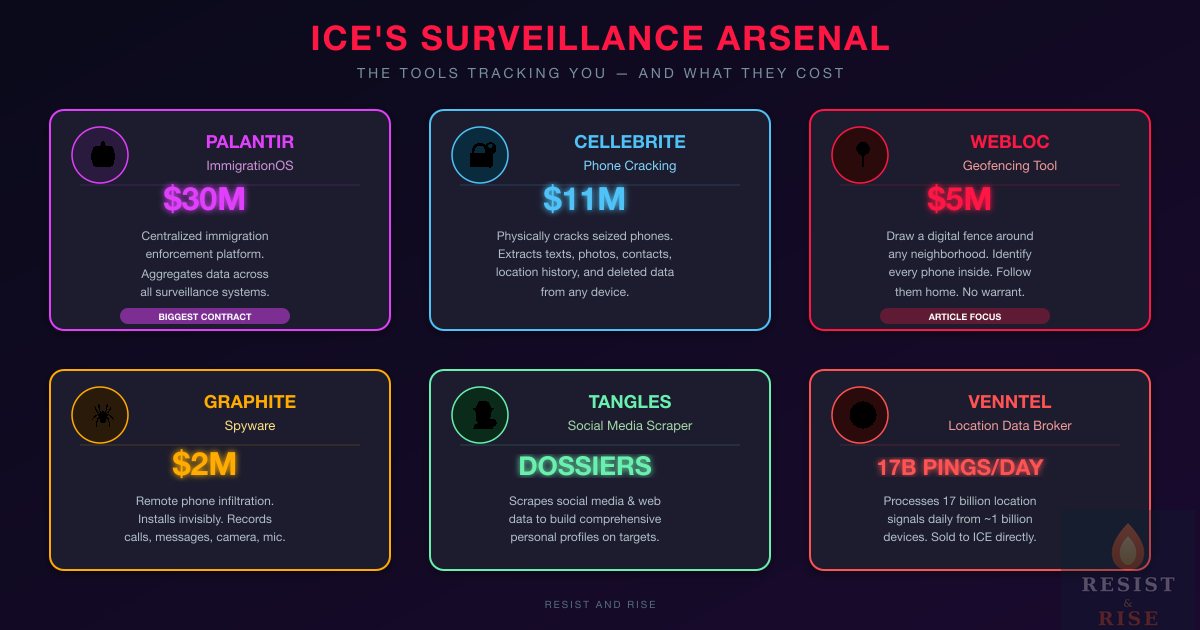
ICE has activated a $2 million contract with Paragon Solutions for Graphite spyware, which can remotely hack into any phone and access encrypted applications. The agency signed an $11 million contract with Cellebrite. They provide devices that crack locked phones and automatically sort through texts, messages, hidden photos, and location history. Palantir has been awarded a $30 million contract through 2027 to build ImmigrationOS, an AI platform designed to “track immigrants’ movements” using data from multiple government sources. Including, according to Fortune, Medicaid records covering nearly 80 million patients.
Nathan Freed Wessler, Deputy Director of the ACLU’s Speech, Privacy, and Technology Project, told IT Magazine, “This is a very dangerous tool in the hands of an out-of-control agency. This granular location information paints a detailed picture of who we are, where we go, and who we spend time with.”
The Legal Loophole That Makes It All Possible
Here is the constitutional shell game that makes this “legal.”
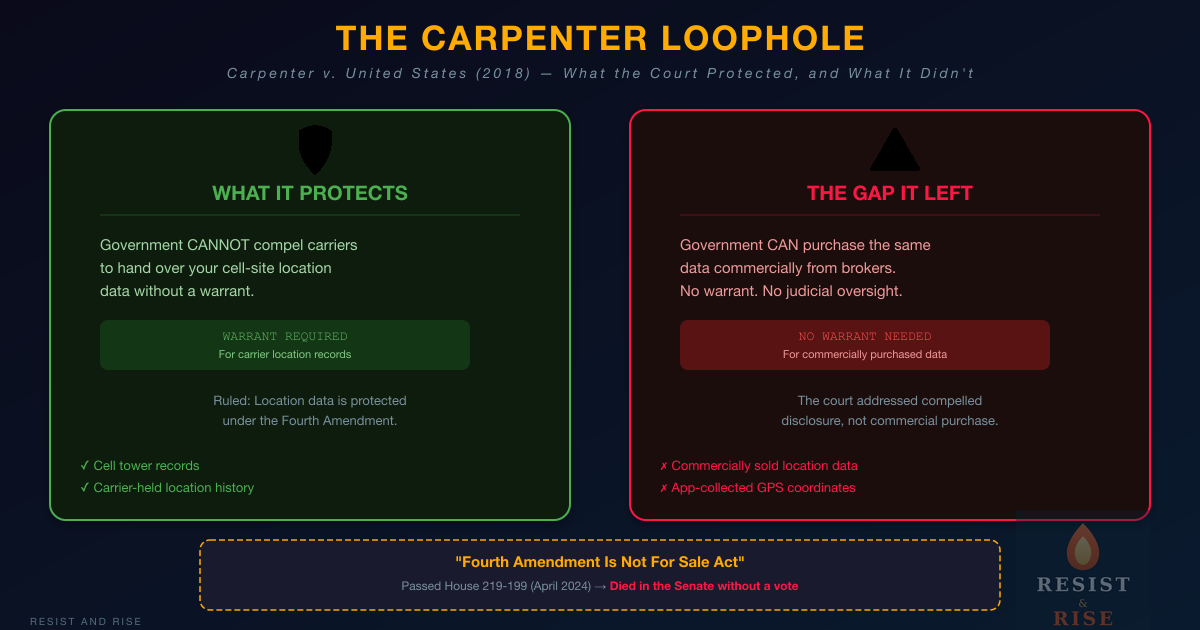
In 2018, the Supreme Court ruled in Carpenter v. United States that the government needs a warrant to access seven or more days of historical cell-site location information from phone carriers. The decision was hailed as a landmark privacy victory. Chief Justice Roberts recognized that such data reveals “the privacies of life.”
But the ruling contained a critical gap. It addressed only the government’s power to compel companies to disclose data. Not its ability to purchase data that companies voluntarily sell through the commercial marketplace.
Federal agencies have driven a truck through that gap.
The Columbia Law Review published a detailed analysis calling this practice “laundering data.” A blatant constitutional end-run around Carpenter’s protections. The Center for Democracy and Technology documented how the Electronic Communications Privacy Act prohibits phone and internet providers from giving sensitive customer information to government agencies without a court order. But this places no restrictions on those same companies selling the data to brokers or on brokers selling it to the government.
The Brennan Center for Justice framed it this way: “Government agencies are relying heavily on data purchases to sidestep the Fourth Amendment’s central safeguard against abusive policing: the requirement that police obtain a warrant from a judge before invading a reasonable expectation of privacy.”
Translation: If the government can’t legally take your location data, it simply buys it on the open market. Same data. Same invasion of privacy. Different checkout counter.
The legislative fix is the Fourth Amendment Is Not For Sale Act. The bill passed the House in April 2024 on a bipartisan 219-199 vote. It would have prohibited intelligence agencies and law enforcement from purchasing Americans’ data without a warrant.
The Senate never voted on it. The bill died with the 118th Congress. It has not been reintroduced.
The Trump administration’s CFPB then withdrew its proposed rule on “Protecting Americans from Harmful Data Broker Practices” in May 2025. The regulation would have treated data brokers as consumer reporting agencies with accuracy standards and safeguards against misuse.
Every guardrail that might have stopped this has been removed, defunded, or allowed to expire. What a coincidence.
The Dragnet Catches Everyone
The word “dragnet” isn’t hyperbole. It’s the conclusion of a two-year investigation.
Georgetown Law’s Center on Privacy and Technology used hundreds of Freedom of Information Act requests to produce “American Dragnet: Data-Driven Deportation in the 21st Century.” Their findings, originally published in 2022 and re-released in May 2025 with a new foreword reflecting on the current political context, are devastating:
· ICE has scanned the driver’s license photos of 1 in 3 U.S. adults.
· ICE has access to the driver’s license data of 3 in 4 U.S. adults.
· ICE tracks the movements of drivers in cities home to 3 in 4 U.S. adults.
· ICE can locate 3 in 4 adults through their utility records.
Annual surveillance spending grew fivefold between 2008 and 2021 alone. Up from $70 million to $400 million per year, according to Georgetown’s research. That was before the $28.7 billion budget.
In a dense city, even a narrow geofence captures everyone. As the Harvard Law Review documented, anyone working at a bank, visiting a psychiatrist next door, worshipping at a church on the neighboring block, or simply walking past on the sidewalk gets swept up.
We know what this looks like in practice.
In 2019, a Florida man named Zachary McCoy received a notice from Google informing him that police had requested his account information in connection with a burglary. McCoy had nothing to do with the crime. His only connection: a fitness app showed him biking past the burglarized home during the approximate time of the crime. To clear his name, McCoy hired a lawyer and fought a legal battle that forced his family to dip into their savings.
In Arizona, Jorge Molina was arrested and held in jail for six days after location data falsely tied him to a murder. He had a solid alibi.
Those cases involved geofence warrants. At least the geofence warrants required police to go before a judge. ICE’s Webloc requires no warrant at all.
The surveillance is now explicitly targeting political expression. In Slate’s February 2026 investigation, a Maine woman filming ICE officers in Portland was told by an agent, “Because we have a nice little database, and now you’re considered a domestic terrorist.”
White House border czar Tom Homan said on Fox News in January 2026, “We’re going to create a database where those people that are arrested for interference… we’re going to make them famous.”
DHS publicly denies such a database exists. DHS Assistant Secretary for Public Affairs Tricia McLaughlin issued an official statement: “There is NO database of ‘domestic terrorists’ run by DHS.”
But according to the same Slate investigation, agents were instructed to “capture all images, license plates, identifications, and general information on hotels, agitators, protestors, etc.”
So there is no database. They are just capturing all the data you would put into a database. Totally different.
The ACLU filed Doe v. DHS on February 2, 2026, to quash a DHS administrative subpoena that sought Google subscriber records about a man who had sent a single email criticizing a DHS attorney’s handling of an Afghan asylum case. Four hours after “Jon Doe” sent his email, DHS issued a subpoena to Google seeking his private information. The Washington Post reported that the volume of DHS administrative subpoenas under the current administration is “well into the thousands, if not tens of thousands.”
Four hours. One critical email. A government subpoena to unmask you.
What It Means
This is not an immigration story. Or rather, it isn’t only an immigration story.
ICE has assembled the most comprehensive domestic surveillance apparatus in American history. Its tools don’t distinguish between citizens and non-citizens, between suspects and bystanders, or between someone attending a protest and someone buying milk across the street.
The technology captures everyone in the zone. The legal loophole permits it. The legislative fixes are dead. The regulatory guardrails have been withdrawn. A coalition of over 500 civil and human rights organizations has written to Congress calling the expanding apparatus a “surveillance panopticon.”
When the government can track every phone in a neighborhood without ever going before a judge, the Fourth Amendment isn’t a protection. It’s a suggestion.
What’s Next
ACLU’s Doe v. DHS case: Filed February 2, 2026. A federal court ruling on whether the government can use surveillance powers to retaliate against constitutionally protected criticism could set a significant precedent. Watch for a ruling in spring or summer 2026. Follow the ACLU.
DHS funding fight in Congress: Senate Democrats stripped the DHS spending bill from a broader package in early February 2026 to force negotiations on ICE and CBP reform. Whether the final bill includes any surveillance restrictions will determine the near-term trajectory of ICE’s surveillance expansion.
Fourth Amendment Is Not For Sale Act: Passed the House with bipartisan support in April 2024 but died in the Senate. Whether it gets reintroduced in the 119th Congress remains unknown. Track at Congress.gov.
What You Can Do
Protect your phone right now:
Disable your advertising ID. This is the single most impactful step. On iOS: Settings > Privacy & Security > Tracking > Disable “Allow Apps to Request to Track.” On Android: Settings > Privacy > Ads > Delete advertising ID. The EFF notes this “will make it substantially harder for advertisers and data brokers to track and profile you.”
Audit your app location permissions. Remove location access from any app that doesn’t absolutely require it. Set essential apps to “While Using” instead of “Always.”
Use a VPN. It encrypts your internet traffic and masks IP-based location data.
If you are in California, use the DROP platform created by the DELETE Act to request data broker deletion. Enforcement begins August 1, 2026.
If you are not in California, manually opt out of data brokers using the guide at stateofsurveillance.org, covering 85+ known brokers.
Demand systemic change:
Call your representatives and demand reintroduction of the Fourth Amendment Is Not For Sale Act.
Support the Fight for the Future congressional letter calling for a complete moratorium on ICE surveillance technology purchases.
Support organizations fighting this: ACLU, EFF, Brennan Center for Justice, Georgetown Center on Privacy and Technology, Fight for the Future.
Your phone is broadcasting your location right now. Nothing stops ICE from purchasing that data without a warrant. Individual protection matters, but only collective action closes the loophole.
Methods & Verification: This article synthesizes reporting and analysis from 404 Media (original documents), the Washington Post, the Electronic Frontier Foundation, the ACLU (litigation filings and policy analysis), Georgetown Law Center on Privacy and Technology (two-year FOIA-based investigation), the Brennan Center for Justice, the Center for Democracy and Technology, Columbia Law Review, FTC enforcement records, and Slate. All claims were cross-referenced across at least two independent sources. Dollar figures, statistics, and legal citations were verified against primary documents, court filings, and government records.
Sources
Georgetown Law, “American Dragnet: Data-Driven Deportation in the 21st Century"—Two-year FOIA-based investigation, 2022, re-released May 2025
americandragnet.org—Full report and data visualization
Brennan Center, “Closing the Data Broker Loophole” —Legal framework analysis
CDT, “Legal Loopholes and Data for Dollars"—ECPA legal framework analysis
NBC News, DHS cellphone location data purchases—July 2022
ConsumerAffairs, ICE surveillance spending—January 2026
Common Dreams, “Coalition Urges Congress to Block All Funding for ICE ‘Surveillance Panopticon’” —2026
The Deportation Panopticon—November 2025